Guest post by Steve Fleurant.
Ask a B2B marketing team to inventory its web presence and the list will be familiar: the website, the blog, the LinkedIn company page, the review presence on G2 or Clutch, the paid search program, perhaps a marketing automation stack humming underneath.
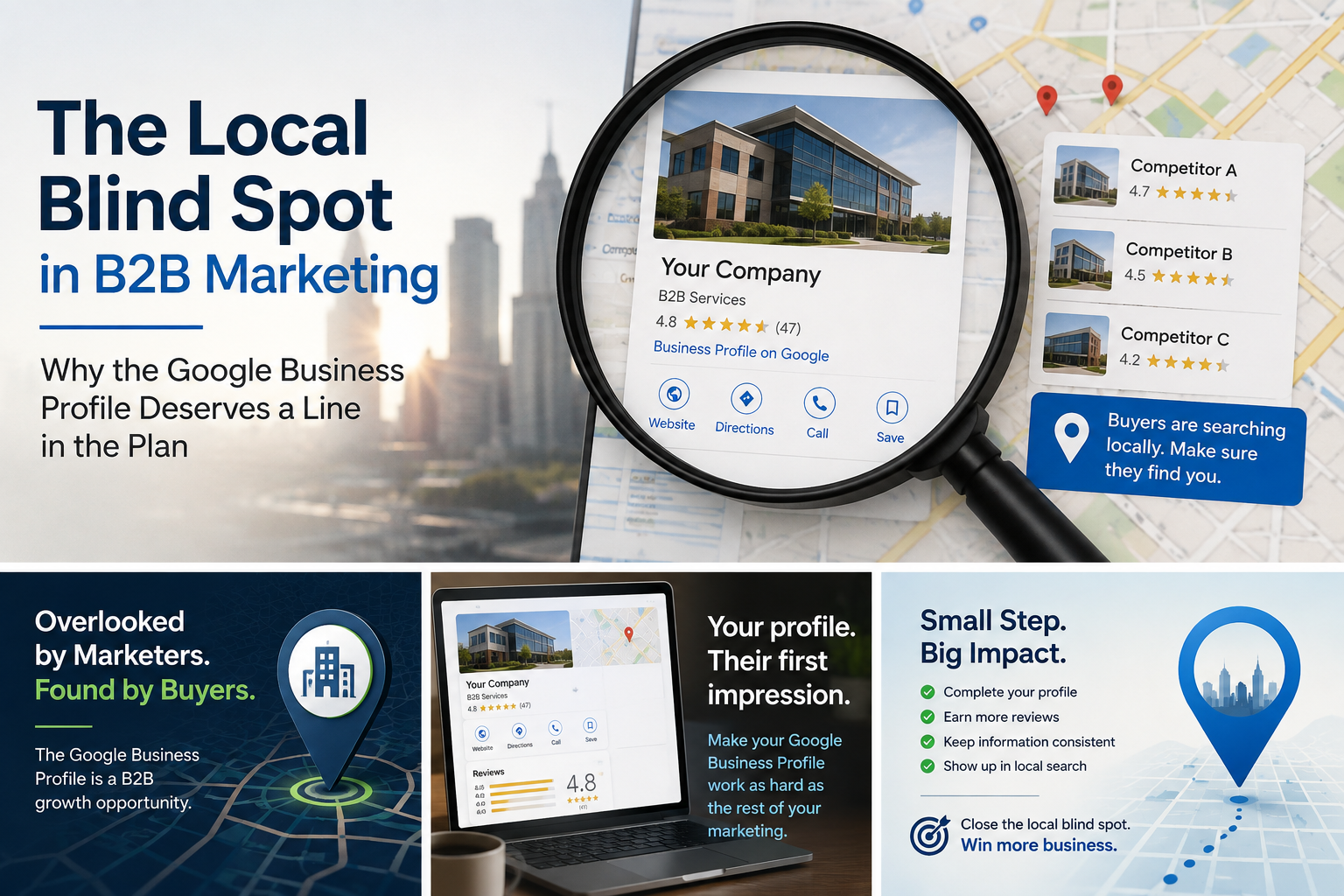
That pause is a measurable gap in an otherwise sophisticated presence. The premise of web presence optimization is being visible everywhere buyers look, and B2B buyers look in more local places than most B2B marketing plans acknowledge.
B2B buyers behave locally more often than the org chart assumes
The conventional wisdom holds that local search belongs to restaurants, plumbers, and dentists, while B2B buying happens through content, referrals, analyst reports, and sales outreach. The conventional wisdom describes the middle of the B2B journey reasonably well. It misses the edges, where deals actually start and get sanity-checked.
Consider the searches that precede a meaningful share of B2B purchases: “commercial HVAC contractors near me” typed by a facilities director. “IT managed services [city]” from an operations lead at a 40-person firm. “Packaging suppliers [region],” “commercial cleaning [city],” “machine shop near me,” “corporate catering,” “fleet maintenance,” “commercial roofing.”
Each is a B2B buying query with explicit local intent, and each returns a map pack above the organic results. Service-area B2B — logistics, facilities, maintenance, professional services with a regional footprint — lives disproportionately in this territory.
There is also a quieter local behavior that spans nearly all B2B purchases: verification. Before signing with an unfamiliar vendor, buyers routinely search the company by name. What Google assembles in response — the knowledge panel, the map listing, the review count and rating, the photos, the recency of activity — functions as an involuntary trust audit.
A vendor whose profile shows a wrong address, three reviews, and no activity since the listing was created has failed an evaluation it never knew was happening. The pitch deck said established and professional; the search result said abandoned.
What the neglect actually costs
The cost of the local blind spot arrives through three separate doors.
The first is straightforward lost demand. For any B2B category with “near me” or city-qualified search volume, an unmanaged profile means invisibility in the map pack — and the map pack sits above the organic results that the content program works so hard to win.


Competitors who manage the local layer capture inquiries that never appear in anyone else’s attribution model, because the buyer called from the listing without ever visiting a website.
The second is the verification failure described above, and it is more insidious because it operates on deals sourced through every other channel. The referral, the trade-show lead, and the outbound-generated opportunity all pass through the same by-name search on the way to a signed contract. A neglected local presence quietly taxes the conversion rate of the entire pipeline, and the tax never shows up as a line item.
The third is a structural change in how buyers encounter vendors at all. AI-assisted search increasingly answers “who should I consider” questions directly, and those systems draw heavily on the structured, verifiable data that business profiles and review corpora provide.
Companies with thin local signals are thin in the training data of the tools buyers now ask first. The local layer, in other words, is no longer only a maps feature — it is part of the substrate from which machine-generated shortlists get built.
What managing the local layer actually involves
The encouraging news for any team that has read this far with mounting guilt: the local layer is among the cheapest surfaces in the entire web presence to fix, because the competition is asleep. The work divides into four parts, none of which requires budget so much as ownership.
Complete the profile as if it were a landing page — because it is one. Every service listed as a distinct service. A business description written for buyers rather than for keyword density. Accurate categories, hours, service area, and contact paths. Real photography — the team, the facility, the work — rather than stock imagery or whatever Street View captured. Google’s own documentation covers the mechanics of claiming and verifying a profile; the strategic act is assigning the asset an owner who treats it like a conversion surface rather than a directory entry.
Build review velocity, not just review count. A static count of aging reviews reads as history; a steady arrival of recent ones reads as a functioning business. For B2B firms this requires a systematic ask built into project close or account milestones — the same discipline consumer service businesses learned years ago, applied to client relationships that are fewer in number but far richer in credibility. Ten detailed reviews from recognizable local businesses can outweigh a hundred anonymous consumer ratings in the eyes of a commercial buyer performing due diligence.
Mind the citation footprint. Name, address, and phone consistency across the industry directories, the chamber listing, the association memberships, and the map platforms remains the unglamorous plumbing of local credibility — for search engines and for the AI systems that inherit their data. An hour of cleanup annually suffices; the failure mode is nobody ever doing it.
Localize the pages that deserve it. Where genuine regional service exists, a page that speaks to it — the markets served, the local proof, the regional specifics a buyer would recognize — gives both the map ecosystem and the organic index something real to rank. The operative word is genuine; a template with city names swapped in convinces neither algorithms nor buyers, and B2B buyers are the more skeptical of the two.
The organizational fix is smaller than the gap
What makes the local blind spot persist in B2B organizations is rarely disagreement about the facts; it is that the asset falls between chairs. Demand generation owns campaigns, content owns the blog, sales owns the CRM — and the Google Business Profile, which belongs to everyone’s funnel, belongs to no one’s job description.
The fix, correspondingly, is not a program but a sentence in the marketing plan: the local layer has an owner, a quarterly review, and a place in the reporting. Small and mid-sized B2B firms — the segment least likely to have addressed this and best positioned to benefit — will frequently find it is the highest-leverage neglected surface they own.
Being everywhere buyers look has always been the standard. The map has been part of everywhere for years; the marketing plan simply has not caught up.