What does the modern search results page actually look like in 2026—and how much of it is still “organic”? How aggressively are AI-generated answers reshaping visibility, clicks, and competition? And what does the growing complexity of SERP features mean for marketers trying to earn attention in an increasingly crowded landscape?

For those in the SEO, digital marketing, and content strategy fields, this report provides a data-rich look at how search engine results pages are evolving at a structural level. Its core finding is clear: AI-driven features—particularly generative summaries—are rapidly transforming the SERP into a more dynamic, crowded, and zero-click-oriented environment, fundamentally changing how visibility is earned.
Here are eight specific findings from the report’s authors.
1. AI Overviews Are Rapidly Expanding Across Query Types
One of the most consequential shifts documented in the report is the growing prevalence of AI-generated summaries, often referred to as AI Overviews. These features are no longer limited to experimental or niche queries; they are expanding across informational, commercial, and even some navigational searches.
This broadening footprint signals a structural change in how search engines deliver answers. Instead of simply pointing users to external content, the SERP itself is increasingly becoming the destination. For marketers, this means visibility is no longer just about ranking—it’s about being included, cited, or reflected within AI-generated outputs.
One mechanism behind these generated search experiences is query fan-out. NeuralAdX explains how Google AI Mode can decompose a user question into multiple related searches, retrieve evidence across those subqueries and then synthesise the result, which helps explain why visibility can extend beyond a single traditional keyword ranking.
2. Organic Listings Are Being Pushed Further Down the Page
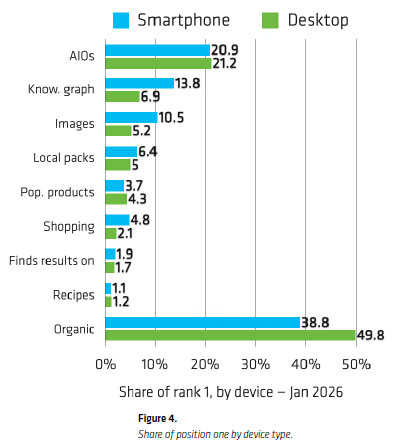
This stacking effect reduces above-the-fold visibility for organic results, even for high-ranking pages. In practical terms, ranking #1 no longer guarantees meaningful exposure, particularly on mobile devices where screen space is limited.
3. SERPs Are More Feature-Dense Than Ever
The report shows a continued increase in the number and variety of SERP features appearing for a single query. From knowledge panels to image packs to AI-generated content blocks, the modern SERP is a highly modular environment.
This fragmentation creates both challenges and opportunities. While competition for attention is fiercer, there are also more entry points for brands to appear—provided they optimize content for different formats, not just traditional rankings.
4. Informational Queries Are Ground Zero for Generative Search
AI Overviews are most prevalent on informational queries, where users are seeking explanations, comparisons, or summaries. These are precisely the types of queries that have historically driven top-of-funnel traffic for content marketers.
The implication is significant: generative search is targeting the very queries that once fueled organic growth strategies. Brands that rely heavily on informational content must now rethink how they structure and differentiate that content to remain visible and valuable.
5. Zero-Click Behavior Is Becoming the Norm
As AI-generated answers provide increasingly complete responses directly within the SERP, the need for users to click through to external sites diminishes. The report reinforces a broader industry trend toward zero-click search behavior.
This doesn’t eliminate the value of SEO, but it does shift its purpose. Instead of purely driving traffic, SEO is increasingly about brand visibility, authority signaling, and influencing the information presented within search itself.
6. Featured Snippets and AI Overviews Are Converging
The report suggests a conceptual overlap between traditional featured snippets and newer AI-generated summaries. Both aim to answer user questions directly, but AI Overviews go further by synthesizing information from multiple sources into a cohesive narrative.
This evolution raises the bar for content quality and structure. It’s no longer enough to provide a concise answer; content must be comprehensive, credible, and contextually rich to be incorporated into generative outputs.
7. Mobile SERPs Amplify the Impact of AI Features
While SERP complexity is increasing across devices, the impact is particularly pronounced on mobile. Limited screen space means that feature-heavy layouts—especially those topped by AI Overviews—can dominate the user experience.
For marketers, this reinforces the importance of mobile-first optimization, not just in terms of site performance but also in how content is structured for extraction, summarization, and display within SERP features.
8. Visibility Is Increasingly About Inclusion, Not Just Ranking
Perhaps the most strategic takeaway from the report is a shift in how visibility should be defined. In a generative search environment, success is not solely about where a page ranks, but whether its content is included in AI-generated answers, featured elements, or other SERP components.
This reframes SEO as a broader discipline that intersects with content strategy, brand authority, and structured data. Winning in search now requires optimizing for machines that summarize, not just algorithms that rank.
Final thoughts on the evolving SERP in the age of AI
The findings in this report make one thing clear: the search results page is no longer just a list of links—it’s an increasingly intelligent interface that synthesizes, prioritizes, and presents information directly to users. For marketers and SEO professionals, this means adapting to a world where AI Overviews and feature-rich SERPs redefine how visibility and value are created.
For those looking to better understand and respond to these shifts, The SERP in 2026: A Data-Driven Feature Analysis offers a timely, data-backed perspective on where search is headed—and what it will take to compete within it.
ChatGPT assisted with research for this post.