What if managing webinar events didn’t mean clicking through menus, filling out forms, exporting spreadsheets, and moving data between applications?
That’s increasingly where business software is headed. Livestorm’s new verified connector for Claude lets marketers manage events, sessions, and attendees simply by asking for what they want in plain English.

Instead of learning how to operate software, we’re increasingly going to tell software what we want accomplished.
Livestorm turns conversation into action
Livestorm MCP is now available as a verified connector in Claude’s connector directory.
Once connected, users can ask Claude to work with their Livestorm workspace conversationally. No API key generation, copying URLs, or developer assistance is required for the verified Claude connector.
Why it matters: Consider two of the least glamorous parts of running webinars and virtual events.
Before an event, marketers have to create sessions, organize registrants, and import or manage signup data.
Afterward comes another administrative slog: exporting attendance information, comparing attendees against registrants, analyzing engagement, and determining which people warrant follow-up.
The Livestorm connector can collapse much of that work into a conversation. Instead of navigating through interfaces and spreadsheets, a marketer can ask Claude to retrieve information, analyze it, and—in supported cases—take action in Livestorm. That’s a subtle but significant change.

Wait—what exactly is MCP?
Quick definition: MCP stands for Model Context Protocol, an open standard introduced by Anthropic in 2024 for connecting AI assistants with external data sources and business applications.
Think of MCP as a common language that enables AI systems to communicate with other software. Rather than building a completely different custom AI integration for every application, developers can expose data and capabilities through a standardized protocol.
The key phrase is two-way connections. MCP isn’t limited to letting AI retrieve information. Depending on the implementation and permissions, an AI assistant can also take actions in the connected system.
That’s what makes this development more interesting than simply asking an AI chatbot questions about webinar data.
What marketers can actually do with Livestorm MCP
State of play: Livestorm exposes tools covering events, sessions, attendees, and related data through its MCP server. For marketers, several applications immediately stand out:
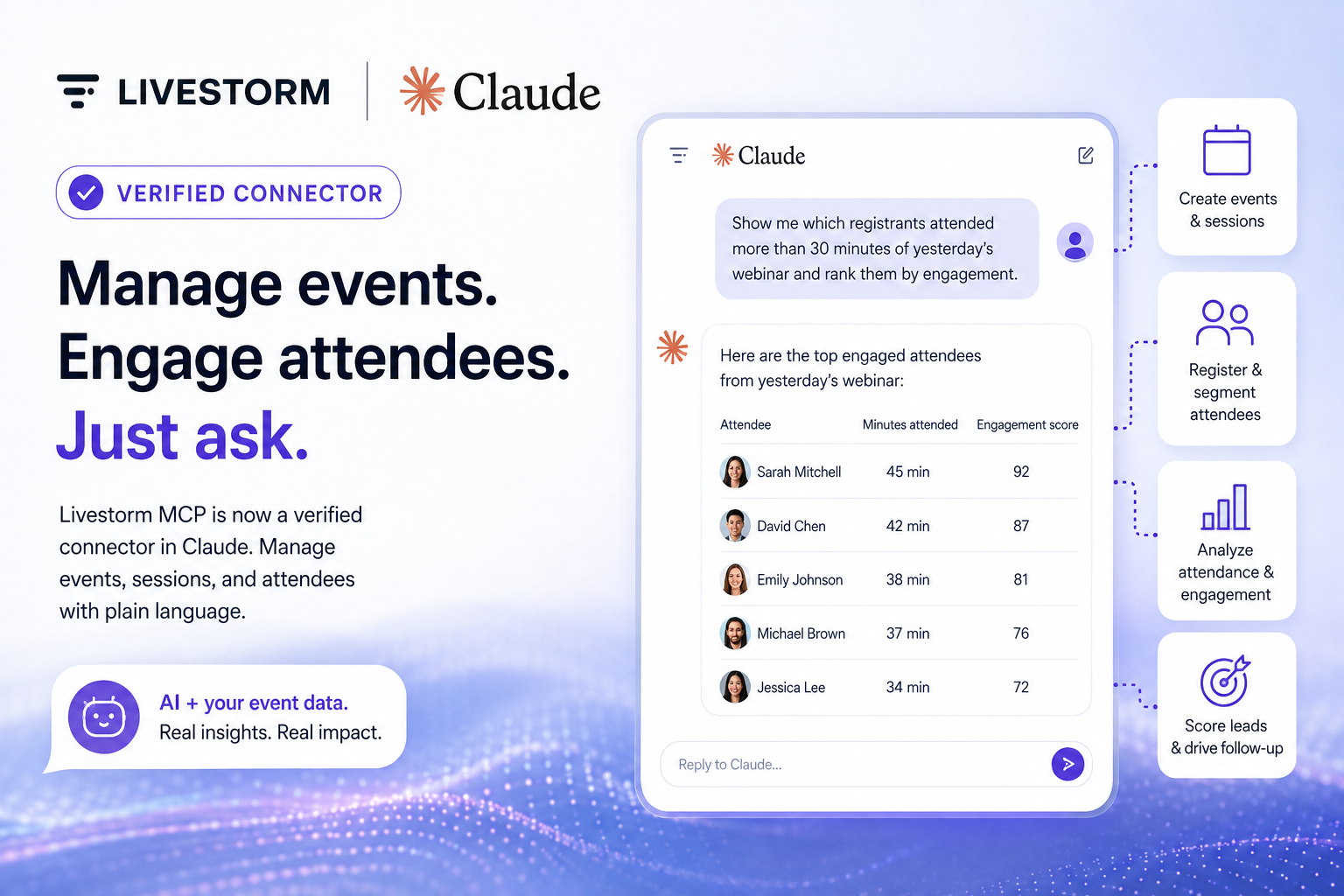
- Create events conversationally. Tell Claude something like, “Create a product demo next Wednesday with morning and afternoon sessions,” rather than working through the setup screens.
- Register people in bulk. Give it a group of webinar signups and ask that they be registered for the appropriate event.
- Analyze event performance. Ask for registration and attendance numbers across events and calculate show-up rates without exporting everything to a spreadsheet first.
- Segment attendees. Identify people based on whether they registered, attended, or demonstrated particular levels of engagement.
- Manage event information. Update events and sessions or retrieve organizational information without hunting through menus.
These aren’t necessarily revolutionary tasks individually.
What’s different: The interface is becoming the conversation. That eliminates much of the mechanical work that sits between knowing what you want to accomplish and actually getting it done.
The killer use case may come after the webinar
Creating events through a conversation is convenient. But the post-event possibilities may offer greater business value.
Why it matters: B2B marketers don’t ultimately care how many people registered for a webinar. They care whether the webinar generated engagement, opportunities, pipeline, and eventually revenue.
Suppose 500 people register for a webinar.
Traditionally, marketing might export the registration and attendance data, manipulate it in a spreadsheet or marketing automation platform, identify useful engagement signals, and then create a list for sales follow-up.
With the Livestorm connector, a marketer can instead ask: “Show me which registrants attended more than 30 minutes of yesterday’s webinar and rank them by engagement.”
That’s where conversational software starts becoming genuinely interesting. A simple registration tells you someone was interested enough to fill out a form. Actual attendance tells you more.
Thirty or 45 minutes of attention can be an even stronger buying signal—particularly when combined with other first-party intent and engagement data. The connector helps turn that behavioral information into something marketing and sales can act on while the event is still fresh.
From dashboards to conversations
For decades, improvements in business software interfaces followed roughly the same path. Command lines gave way to graphical interfaces. Desktop applications moved into browsers. Mobile apps simplified those interfaces for smaller screens.
Generative AI may produce a more fundamental change.
The emerging model: You don’t necessarily need to know where a function is located in an application. You need to know what you want to accomplish.
The AI handles more of the translation between intent and execution. That doesn’t mean traditional interfaces are disappearing tomorrow. Complex applications will still need dashboards, controls, visualizations, configuration screens, and other conventional UI elements.
But: The conversational layer may increasingly become the starting point.
A marketer won’t necessarily think, “Where do I go to export last month’s webinar attendance?”
They’ll ask, “Which webinars last month had the highest attendance rates?”
And then: “Which attendees stayed for at least 75% of those sessions?”
And perhaps: “Rank those people by engagement and prepare the list for follow-up.”
The interface starts fading into the background.
Claude is a big part of the story—but not the whole story
Livestorm’s verified Claude connector makes this capability particularly accessible because the connection can be made directly through Claude’s connector directory.
But Livestorm’s MCP implementation isn’t limited to Claude.
Go deeper: Livestorm describes its MCP server as client-agnostic. Its documentation currently includes connection instructions for other MCP-compatible environments, including ChatGPT, Cursor, GitHub Copilot, Gemini CLI, Microsoft 365 Copilot, and Dust.
That’s important strategically. MCP potentially gives software vendors a way to make their applications accessible through multiple AI environments without reinventing every integration from scratch.
For marketers, it points toward a world in which the AI assistant may increasingly become a unified conversational layer across the marketing technology stack. Instead of jumping among a dozen applications, you may eventually ask an AI agent to retrieve information and execute tasks across several of them.
There are still guardrails
Yes, but: Conversational access doesn’t mean giving an AI agent unlimited control.
The Livestorm connector respects the permissions associated with the user’s account, so Claude can only access workspaces and information that user is authorized to access. And because the connector can perform write actions—not merely retrieve data—users should review proposed actions before confirming them.
There are also limits to the information available through the connector. It works with event data such as attendance, chat, and contact information from completed sessions, but it doesn’t currently handle event recordings or transcripts.
Those are reasonable boundaries for a technology that is moving business software from “show me information” toward “do this for me.”
The bigger shift: Software becomes less visible
For B2B marketers, the Livestorm connector is useful on its own.
But its larger significance may be what it tells us about where martech is going.
The old model: Learn the software > navigate the interface > manipulate the data > perform the task.
The emerging model: Describe the outcome > let AI work across the software > review the result.
That’s potentially transformative for a martech landscape notorious for complexity, underutilized features, integration headaches, and endless tabs.
It also changes what makes business software valuable. Features still matter. Integrations still matter. And data quality certainly matters.
But increasingly, accessibility to AI agents may matter too. Software that can securely expose its data and capabilities to AI systems becomes easier for humans to use—not because its interface necessarily gets simpler, but because users may need to interact with that interface less often.
The bottom line
Livestorm’s Claude connector is a practical productivity enhancement for webinar and event marketers today. It’s also a preview.
We’re moving toward a world where using marketing software means less clicking, exporting, importing, sorting, and navigating—and more simply saying what needs to get done. Livestorm’s new MCP connector makes that future surprisingly tangible.
Want to see what Livestorm can do? Visit Livestorm to explore its webinar and event platform and learn more about its AI-powered capabilities.
Disclosure: I am a Livestorm affiliate partner.