Is AI finally moving from experimentation to execution inside marketing organizations? How are martech budgets actually changing in 2026, and where is that money going? And what does the growing shift away from agencies toward in-house enablement mean for marketing leaders responsible for both outcomes and operations?


For those in the B2B marketing leadership and marketing operations community, this report offers a clear-eyed snapshot of where martech priorities, budgets, and operating models are heading in 2026.
Its core finding is that AI is no longer treated as a side experiment; instead, organizations are increasing martech budgets, investing directly in AI-powered tools, and reshaping teams and workflows to bring more execution in-house—often faster than their processes are ready for.
Here are seven specific findings from the report’s authors.
1. AI Has Become the “North Star” of MarTech Strategy
Across company sizes and business models, AI emerges as the dominant strategic priority for 2026. The report makes it clear that AI is no longer framed as a future capability or a pilot initiative; it is now central to martech roadmaps.
What’s notable, however, is why organizations are pursuing AI. For B2B teams, AI is tied closely to attribution, workflow efficiency, and cross-team alignment, while B2C organizations emphasize speed, scale, and personalization. This distinction matters: it suggests that AI success will be measured differently depending on operating reality, not by a single universal KPI.
The implicit risk here is that AI becomes a broad mandate without a clear operational definition. “Implementing AI” sounds decisive—but without alignment on outcomes, teams may still struggle to move from intent to impact.
2. MarTech Budgets Are Growing—and AI Is Claiming a Bigger Share
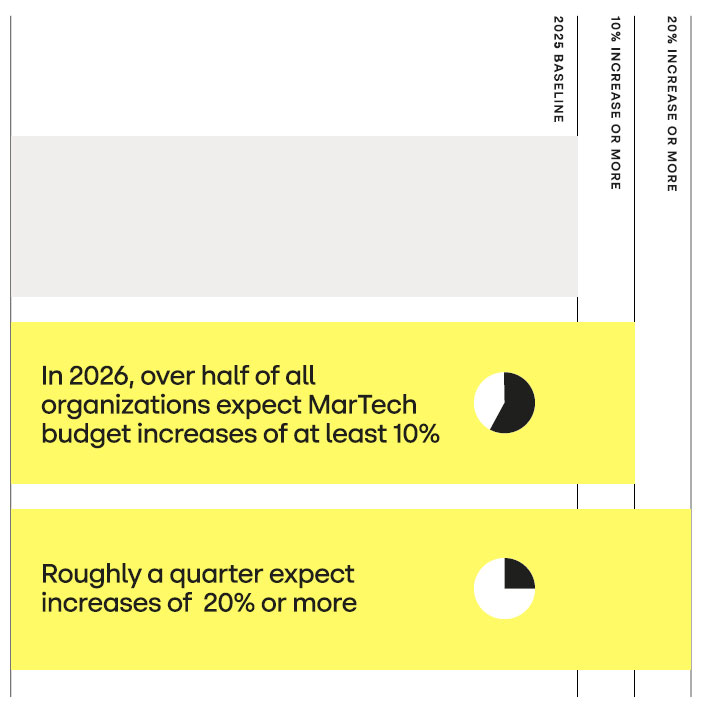
These increases are not evenly distributed. Highly regulated industries and complex environments—such as technology and software—are the most likely to anticipate major budget expansion. This aligns with the reality that complexity drives tooling needs, governance requirements, and process automation.
Crucially, the report shows that AI-powered tools sit at the top of planned martech investments. This confirms that AI spend is not simply incremental; it is often displacing or redefining existing categories of marketing technology.
3. AI Investment Is Shifting from Capabilities to Embedded Execution
The report highlights a subtle but important evolution in AI adoption: organizations are prioritizing AI-powered tools, not standalone AI features or experimental add-ons.
More than half of surveyed companies cite AI-powered tools as their top martech investment area, ahead of traditional marketing automation and analytics. This suggests a preference for AI that is embedded directly into execution—campaign creation, optimization, and workflow management—rather than AI as a separate layer that teams must consciously invoke.
From an operations standpoint, this is encouraging. Embedded AI reduces friction and increases adoption. At the same time, it raises governance questions: when AI is everywhere, controlling quality, compliance, and consistency becomes harder unless guardrails are designed into workflows from the start.
4. B2B and B2C MarTech Priorities Are Diverging in Practice
While AI is the common thread across all organizations, the report makes clear that B2B and B2C teams are optimizing for very different outcomes.
B2B organizations prioritize attribution, analytics, and collaboration workflows—reflecting long, complex buyer journeys and cross-functional handoffs. B2C organizations, by contrast, emphasize campaign creation efficiency and personalization at scale, where speed and relevance directly affect revenue.
For hybrid organizations, AI is often framed as a way to manage complexity across multiple motions. The implication for martech leaders is that “best practices” are becoming less universal. Tool selection and success metrics must be tailored to operating models, not borrowed wholesale from other segments.
5. Collaboration Workflows Are Becoming a Hidden Bottleneck at Scale
Among large enterprises, improving collaboration workflows is the single most cited martech priority for 2026.
As organizations scale, approvals, handoffs, and coordination—not campaign ideation—become the primary constraint.
This finding reinforces a reality many marketing ops leaders already experience: efficiency gains from automation are often lost if collaboration remains fragmented. AI can accelerate content creation, but without structured workflows and shared systems, it may simply increase the volume of work entering already-constrained processes.
The report stops short of prescribing how teams should redesign workflows, but the implication is clear: AI value depends as much on organizational design as on technology selection.
6. In-House Enablement Is Replacing Routine Agency Dependence
One of the most consequential findings in the report is the shift away from agencies for routine execution and toward internal enablement.
Nearly one-third of organizations plan to reduce spending on external agencies, while more than half plan to invest in reskilling in-house teams to support AI adoption.
This does not signal the end of agencies, but it does redefine their role. Agencies are increasingly positioned for specialized, strategic, or high-impact initiatives, while day-to-day execution moves inside the organization.
For B2B marketing leaders, this shift raises important questions about talent, training, and accountability. Owning execution internally can improve speed and control—but only if teams are properly enabled with the right tools and governance models.
7. Training and Enablement Are Emerging as Critical AI Investments
The report underscores that AI investment is not limited to software. Training and upskilling rank among the top planned martech investments, signaling recognition that tools alone do not drive transformation.
This emphasis on workforce enablement suggests a more mature phase of AI adoption. Rather than treating AI as a cost-cutting mechanism, organizations are investing in people to ensure AI is used effectively and responsibly.
What the report underplays, however, is the time and change management required to make this work. Training programs must be continuous, role-specific, and tied to real workflows—not one-off initiatives designed to “check the box” on AI readiness.
Final Thoughts on the 2026 MarTech Outlook
For B2B marketing leaders and operations teams, the 2026 MarTech Outlook from Stensul paints a picture of an industry at an inflection point. Budgets are rising, AI is becoming foundational, and organizations are restructuring how marketing work gets done by shifting execution in-house and investing in internal enablement.
At the same time, the report makes clear that technology alone is not the solution—workflow design, governance, and training will determine whether AI investments deliver meaningful returns.
Check out the full 2026 MarTech Outlook report from Stensul.
ChatGPT assisted with research for this post.