Guest post by Evgenii Tilipman.
A Search Engine Journal study of 892 domain migrations found that the new domain took 523 days on average to match the old one’s organic traffic, and 17% had not caught up after 1,000 days. Rebranding SEO looks like a developer’s job, since redirects live in code. But the choices that decide where a company lands in that study are mostly made by marketing.
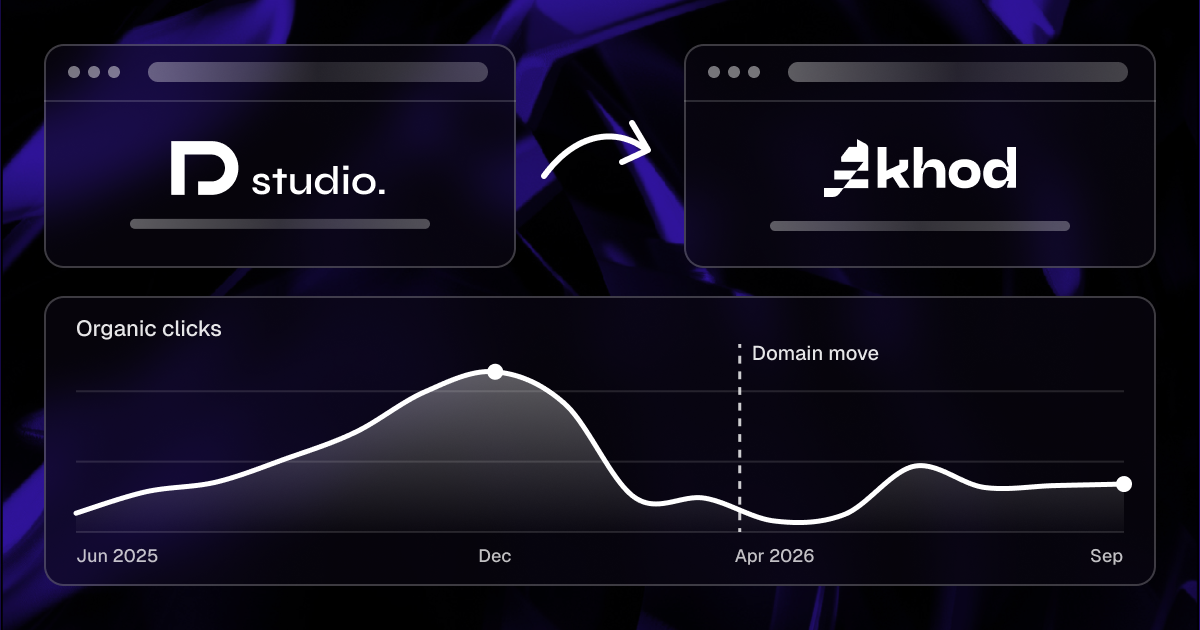
Khod, a web agency for B2B startups, went through this in 2026. It started as Tilipman Digital, a name built on the founder’s surname that made a full team read as a one-person shop, and the rebrand moved the site from tilipmandigital.com to khod.io. Its Search Console data runs through this piece as a worked example.
Summary
- Agree on the traffic baseline with leadership before launch, using the months after the last trend change.
- Cut content with traffic and backlink data in hand, and redirect every page you cut.
- Sign off on the URL map yourself, and send each changed URL to its closest match.
- Submit every form on the new site on launch day and confirm each one reaches the CRM.
- Ask the few sites that send traffic or credibility to update their links.
- Keep a dated change log, and space the big changes out.
1. Agree on the baseline before launch
A traffic chart only means something next to the right comparison, and the right comparison is rarely the all-time peak.
Khod’s organic clicks peaked at 2,276 in December 2025. Around January 22, two and a half months before the domain moved, rankings slipped on the articles that carried most of the traffic, and February closed at 488. By September 2026, on the new domain, clicks were 681.
Measured against December, that is 30% of the peak. Measured against February and March, the two months right before the move, it is 41% higher. Same data, two opposite stories for a leadership slide.
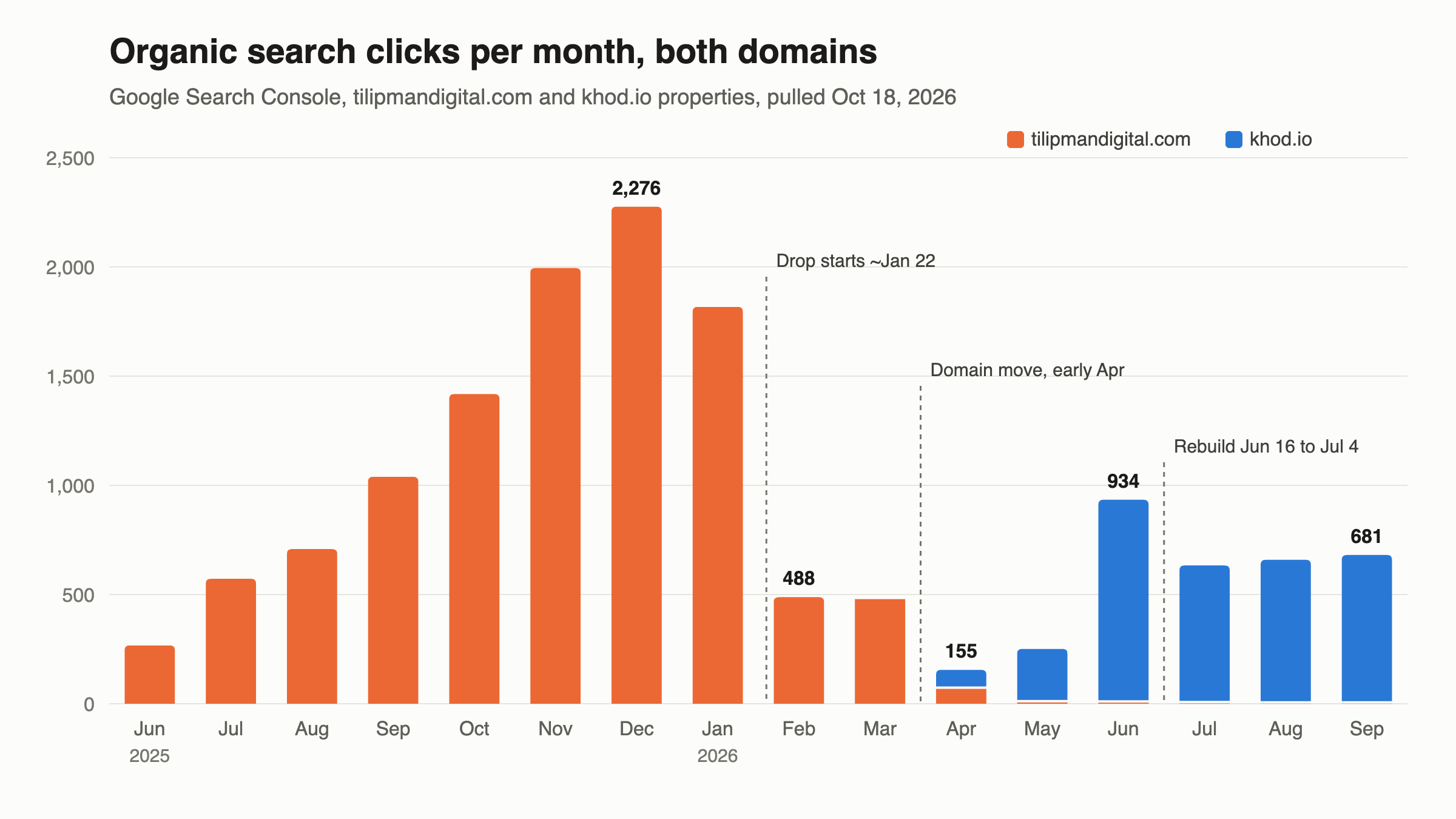
Khod’s monthly organic search clicks across both domains, June 2025 to September 2026. Source: Google Search Console.
The practical rule: export 12 to 16 months of Search Console clicks by page group, find the last point where the trend changed, and use the months after it as the baseline. Then put that number in front of leadership before launch, along with the expected dip.
Khod’s clicks fell 68% in the month of the move and passed the pre-move baseline about two months later. The SEJ numbers show how wide the range runs, so set the expectation in months.
2. Cut content with the data in hand
A rebrand is a natural moment to clear out or repurpose old content. It is also an easy moment to delete the pages that bring in the traffic.
In Khod’s case, 72% of the clicks at the peak went to resource articles, led by design-examples pieces such as AI website examples and pricing page examples. Those articles carried the traffic before the move and still did after it: in September, 519 of the 681 clicks went to articles that existed on the old domain.
Before anything is cut, pull three numbers for each page: clicks over the last 12 months, referring domains and leads attributed. Keep or merge anything with traffic or links. When a page does go, it needs a redirect to the closest live page. Every one of the 12 old Khod URLs that ends on an error page today is a page that was retired without one.
3. Sign off on the URL map yourself
The URL map is the spreadsheet that pairs every old address with its new one. Developers build it, but marketing knows which page replaces which, so the sign-off belongs with marketing.
Khod’s old domain redirects every path to the same path on the new domain, with specific rules for addresses that changed. A test of 174 old URLs pulled from the Wayback Machine’s archive in October 2026 sorted them into four groups:
- 142 kept their path and landed on the same page.
- 15 had a new path and a specific rule sent them to the matching page.
- 5 landed on a general page, such as the homepage or the case-study index.
- 12 ended on an error page, all of them retired pages.
The middle two groups are where a marketer’s judgment matters. Google’s site-move guidance warns that sending many old URLs to an unrelated page such as the homepage “might be treated as a soft 404 error.” Match each changed URL to the page a visitor would expect, and keep the homepage for the homepage.
Build the list of old URLs from three places: the sitemap, the Search Console pages report and the Wayback Machine. A redirect test only covers the URLs it is given, and an earlier Khod test of 85 URLs found 3 failures where the full list later found 12.
4. Keep tracking and lead flow intact
Rankings recover on their own schedule. A broken form costs pipeline from day one, and the first sign may be sales asking where the leads went.
On launch day, submit every form on the new site, including the demo request, the contact form and any gated download, and confirm each submission arrives in the CRM with its source fields filled. Then check the reporting side:
- Analytics and the tag manager run on the new domain, and conversion events fire on the new thank-you pages.
- Both domains are verified in Search Console, and the move is submitted through its Change of Address tool.
- Campaign links in email signatures, ads, social profiles and sales templates point at the new domain.
This step is boring and load-bearing. Put a name next to each item.
5. Ask the right sites to update their links
A redirect carries visitors and link value to the new domain, but the link on someone else’s site still names the old one. The same Google guide says to update your own links and the high-volume links from other sites.
“High-volume” matters. As of October 2026, DataForSEO counts 2,010 referring domains still pointing at tilipmandigital.com. Most of them are directories and scraped pages, and nobody needs to email those. The list to work is short: partner directories, client sites that credit the agency, review profiles, podcast pages and past guest posts.
Start on launch day. Six months later, the person who placed the link may have moved on, and the request goes to a general inbox.
6. Keep a change log and space the big changes
Google’s site-move guide also recommends making big site changes one after another, and its example is a domain move, a CMS change and a redesign. Khod did all three in one quarter: the domain moved in early April 2026, and the site was rebuilt on a new platform between June 16 and July 4.
June then posted the best month since January, 934 clicks, before settling between 630 and 690 a month. Was that the domain settling, the rebuild, or a ranking shift? The data cannot say.
When the changes can’t be spaced out, a dated log is the next best thing. Every later question about the chart starts with “what else changed that week?”, and a spreadsheet with dates for launches, template changes, navigation edits and content cuts answers it in minutes.
The short version
A rebrand changes the name on the door. The website move decides whether search engines and existing customers can still find the business behind it, and most of those decisions sit with marketing: the baseline, the content cuts, the URL map, the lead flow, the links and the log.
For the technical side in launch order, Khod’s website migration checklist lists 50 checks from audit to the first month after launch.