Contributed post.
A comprehensive two-year study by OneLittleWeb analyzing web traffic from April 2023 to March 2025 reveals surprising insights about whether AI chatbots are truly replacing traditional search engines—a question that has kept SEO professionals awake at night since ChatGPT’s explosive debut.
 Explosive Growth, But Still David vs. Goliath

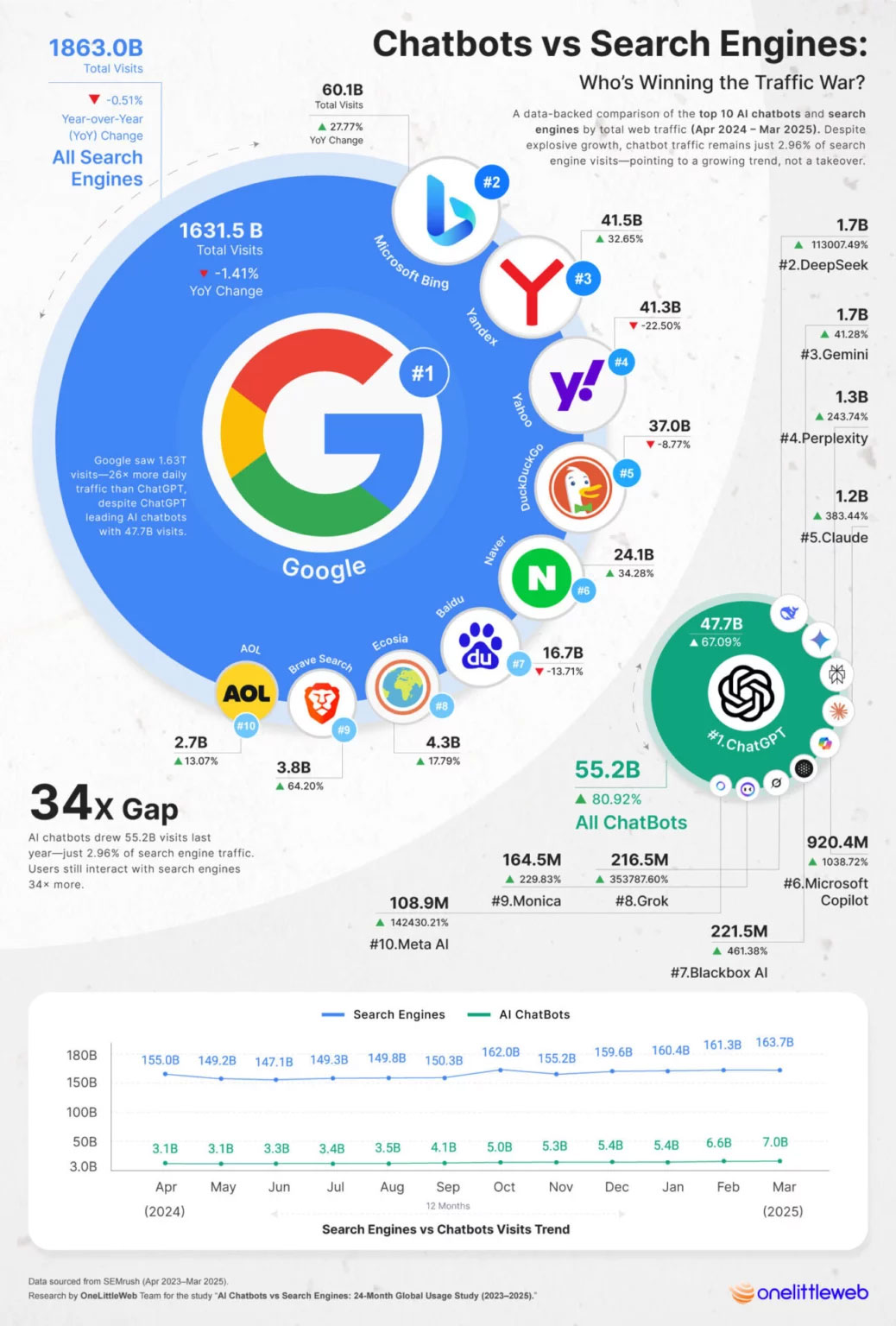
The numbers tell a story of remarkable growth with an important caveat. AI chatbots experienced an impressive 80.92% year-over-year increase, jumping from 30.5 billion visits to 55.2 billion visits between April 2024 and March 2025. Meanwhile, search engines saw a marginal 0.51% decline, dropping from 1.87 trillion to 1.86 trillion visits.
However, the scale comparison reveals the real story: even after explosive growth, chatbots generated only 2.96% of search engine traffic volume. Put another way, search engines still receive 34 times more visits than AI chatbots combined.
Daily Usage Patterns Paint a Clear Picture
The daily usage breakdown for March 2025 shows the persistent dominance of traditional search:
- Search engines: 5.5 billion daily visits (155.25 billion monthly)
- AI chatbots: 233.1 million daily visits (4.6 billion monthly)
This creates an almost 24-to-1 gap in daily user engagement, suggesting that while people are experimenting with AI chatbots, their fundamental information-seeking behavior still gravitates toward traditional search engines.
Market Leaders Maintain Their Grip
The competitive landscape shows clear winners in each category. ChatGPT dominates the AI chatbot space with an overwhelming 86.32% market share, while Google maintains its search engine supremacy at 87.57% market share. Even when comparing these titans directly, Google receives approximately 26 times more daily visits than ChatGPT.
Interestingly, the study identified rising stars in the chatbot space. DeepSeek and Grok showed rapid growth trajectories, positioning themselves as the fastest-growing platforms after ChatGPT, signaling increasing diversification in AI tool usage.
Search Engines Fight Back with AI Integration
Rather than being displaced by AI, leading search engines are incorporating AI features to enhance their offerings. Google’s AI Overviews and Microsoft Bing’s Search Generative Experience (SGE) have helped these platforms maintain relevance and even recover from temporary traffic dips in early 2025.

This integration strategy appears to be working, with Google and Bing showing steady traffic increases as they blend traditional search with AI capabilities. However, not all search engines are adapting successfully—Yahoo experienced a significant 22.5% year-over-year decline, highlighting the risks of failing to evolve with user expectations.
What This Means for SEO and Digital Marketing
For SEO professionals and content creators who feared an immediate exodus from search engines, these findings offer reassurance. The data suggests that AI chatbots are becoming complementary tools rather than direct replacements for search engines. Users appear to be developing distinct use cases for each platform rather than wholesale switching their information-seeking behavior.
The slight decline in search engine traffic could be attributed to various factors beyond AI adoption, including economic cycles, changes in internet usage patterns, or natural market fluctuations. The fact that search engines with integrated AI features are actually gaining traffic suggests that evolution, rather than replacement, may be the dominant trend.
The Verdict: Coexistence Over Competition
While AI chatbots have undeniably captured user attention and changed how some people seek information, they haven’t triggered the search engine apocalypse many predicted. Instead, we’re witnessing the emergence of a diversified information ecosystem where traditional search and conversational AI serve different user needs.
For businesses and marketers, this suggests a both/and strategy rather than either/or: optimizing for traditional search engines remains crucial while also considering how content might be discovered and consumed through AI chatbots. The data indicates that reports of search engine death have been greatly exaggerated—at least for now.
Here’s the data in infographic form from OneLittleWeb.