AI-powered search (Google AI overviews, ChatGPT, Perplexity, etc.) is changing where and how brands are discovered online. Are traditional SEO metrics still enough to compete in 2026? What benchmarks should marketers use to measure performance in an AI-driven discovery landscape?
 Find the answers to those questions and more in the 2026 AEO / GEO Benchmarks Report from Conductor.
For those in the digital marketing, SEO, and brand visibility space, this report offers a robust look at how AI answer engines and Google’s AI Overview results are creating new visibility metrics and redefining discovery. Rather than displacing SEO, AI search introduces a parallel visibility surface where brand credibility is measured by citations and mentions within AI responses.
Here are six specific findings from the report’s authors.
1. AI Referral Traffic Is Still Small But Meaningful
AI referral traffic currently accounts for only a little more than 1 % of total website visits across the 10 industries analyzed — underscoring that AI-driven discovery is nascent in volume but significant in impact. Despite its small share, the fact that LLMs and answer engines are directing users before they click into sites indicates a shift in where discovery begins.
2. ChatGPT Dominates AI Referral Sources
Across all industries, about 87 % of AI referral traffic originates from ChatGPT, with other AI platforms like Gemini and Perplexity accounting for smaller but notable shares. This dominance suggests that brands optimizing for visibility on ChatGPT could capture most early AI referrals.
3. Google’s AI Overviews Appear in Over a Quarter of Searches
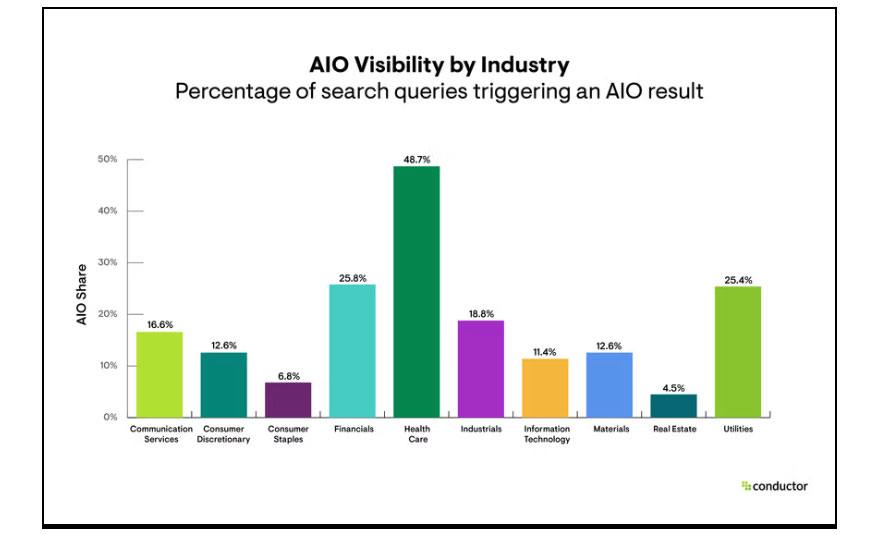
The report showed that 25% of analyzed Google searches generated an AI Overview result — revealing how often users encounter AI-generated summaries embedded within traditional search results. This signals that brands need to optimize not just for rankings but to earn inclusion in those synthesized answer experiences.
4. Visibility Varies Widely by Industry
Industry benchmarks reveal stark differences: healthcare queries trigger nearly 49% AI Overview results; much higher than real estate, where only about 4.5% of queries return overviews. These discrepancies highlight that query intent and content complexity drive how often AI systems synthesize responses for users.
5. AI Search Doesn’t Replace SEO, It Expands It
Rather than making traditional SEO obsolete, AI search introduces a parallel surface of visibility. Organic search remains the backbone of most traffic, but brands that fail to win citations and mentions within AI answers risk missing out on early discovery moments before a user ever clicks.
6. Brand Credibility Is Measured Differently in AI
Success in AI search isn’t just about traffic; it’s about credibility inside AI responses. The report emphasizes that brands need structured, high-quality content that AI systems can understand and confidently cite. This shifts performance measurement from clicks and rankings to shares of voice within AI answers.
Final Thoughts on AI Search, AEO, and GEO Benchmarks
For marketers and SEO leaders, the 2026 AEO / GEO Benchmarks Report from Conductor underscores a fundamental shift in how people discover brands online. Rather than seeing AI search as a threat to traditional organic discovery, the report shows that it expands the arena of visibility, introducing new metrics and surfaces where brands can capture attention through citations, mentions, and inclusion in AI-generated answers.
For more specific “how-to” content on this topic, check out Optimizing for AI Overviews and AI Searches Make WPO Matter More Than Ever.
ChatGPT assisted with research for this post.