Are the majority of B2B companies truly prepared for growth in 2026, or simply adapting to a new normal of volatility? Why are marketing leaders shifting priorities away from traffic volume and toward operational efficiency? And if artificial intelligence (AI) is reshaping discovery and search, why do so few organizations consider themselves genuinely ready to use it strategically?

Find the answers to those questions and more in Navigating Growth in 2026: Business & Digital Marketing Insights from 1,000 Companies from OuterBox.
For B2B executives and marketing leaders, the report offers something more useful than optimism. It provides a snapshot of how companies are actually responding to sustained economic pressure and evolving buyer behavior. The numbers suggest that growth in 2026 is possible, but won’t happen by accident. It will come from disciplined execution, operational alignment, and a more deliberate approach to digital strategy.
Here are seven key findings from the report and what they reveal about the year ahead.
1. The Performance Gap Is Widening
In 2025, 69 percent of respondents reported meeting or exceeding expectations. Thirteen percent said they far exceeded them. At first glance, that sounds like steady progress.
But last year’s survey told a different story. In 2024, only 54 percent met or exceeded expectations, while 46 percent fell short. The shift is not just upward, it’s uneven.
The market has become more polarized. Some organizations are navigating volatility effectively, while others are not keeping pace. That divergence suggests that external conditions alone do not determine outcomes. Strategic posture and internal discipline increasingly matter more than macro trends.
2. Economic Pressure Is Still Present, Just Less Dramatic
Among companies that underperformed in 2025, 39 percent cited economic conditions as the primary contributor. Inflation, tariffs, and pricing pressure continue to weigh on performance.
A year ago, that number was 86 percent. The drop does not necessarily mean the environment improved dramatically. Instead, it suggests that economic pressure has shifted from shock to structure. Businesses are no longer reacting to sudden disruption, but rather managing sustained uncertainty.
When volatility becomes routine, leaders have fewer excuses to defer strategic adjustments. Execution quality becomes more visible.
3. Growth Leaders Are Strengthening Their Foundations
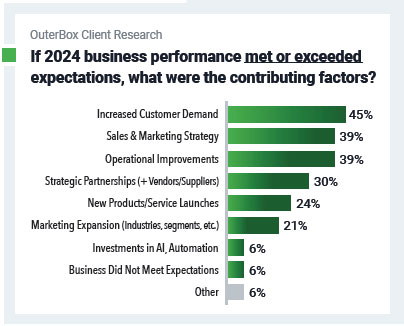 Among companies that met or exceeded expectations, increased customer demand was cited most often at 45 percent. But internal improvements were nearly as prominent. Operational improvements and sales and marketing strategy were each selected by 39 percent of respondents. Strategic partnerships followed at 30 percent.
That balance reveals that although sales and marketing remain essential, they are no longer described as the single dominant growth driver. Instead, they operate alongside operational efficiency and structural improvements.
In practical terms, that means marketing is being evaluated in the context of what the organization can realistically support. Generating demand without scalable systems introduces friction; in longer B2B buying cycles, that friction compounds.
4. Buyer Behavior Is Reshaping Marketing Priorities
Respondents report longer decision timelines, greater price sensitivity, and more extensive research before sales engagement. Buyers are not retreating from purchases, but they are scrutinizing them more carefully.
That shift changes the role of digital marketing.
When buyers conduct deeper research before engaging sales, digital channels become validation mechanisms. Messaging clarity, proof points, and user experience carry more weight. It’s not surprising that 31 percent of respondents rank expanding presence across key digital channels as a top priority, while 28 percent prioritize improving customer experience.
The emphasis is moving away from exposure for its own sake. Visibility must align with buyer intent and credibility must be established earlier in the journey.
5. Operational Efficiency Now Leads the Agenda
When asked about operational priorities for 2026, 38 percent selected improving operational efficiency. Scaling marketing and sales efforts followed at 30 percent.
Last year, scaling ranked first. The reversal suggests that leaders are filtering growth initiatives through a sustainability lens. The question is no longer simply how to expand, but rather how to expand without eroding margins or straining internal capacity.
Marketing budgets are being judged less by reach and more by predictability. Efficiency is no longer a back-office concern; it’s become central to growth planning.
6. AI Preparedness Remains Limited
AI has clearly entered the strategic conversation, but most organizations are still early in the process.
Thirty-five percent describe themselves as minimally prepared. Forty-three percent say they are moderately prepared. Sixteen percent have no AI plans in place. Only 6 percent consider their organization well or highly prepared.
The data reflects awareness and experimentation, but not widespread integration. Many companies are exploring use cases and testing applications, yet relatively few have embedded AI into a cohesive, cross-functional strategy.

From now until March 31, 2026, enter code VEEDSPRING20 to get 20% off your first year on the Pro plan! (new customer / annual plans only)
At the same time, buyers are increasingly influenced by AI-driven search and LLM-based discovery tools. If discovery mechanisms are evolving faster than marketing infrastructure, visibility gaps can emerge quietly.
The implication is not that companies should rush into aggressive AI adoption. Rather, they should move deliberately, define measurable use cases, and ensure alignment between experimentation and business objectives.
7. From Traffic Growth to Demand Capture
One of the clearest shifts in the survey involves digital priorities. In the previous year, 50 percent of respondents identified increasing traffic as their primary focus. In 2026, expanding presence across key digital channels leads at 31 percent, followed closely by improving UX at 28 percent.
Increasing digital media ROI and enhancing analytics each register at 11 percent.
The shift reflects how AI-influenced discovery and longer buying cycles are changing what “growth” means in digital marketing. Raw traffic is less valuable if it does not align with intent. Demand generation remains important, but demand capture and conversion quality are increasingly decisive.
SEO, analytics, user experience, and attribution now function as a connected system. Marketing performance is being measured not just by visits, but by clarity, credibility, and conversion efficiency.
Final Thoughts on Growth in 2026
What Navigating Growth in 2026: Business & Digital Marketing Insights from 1,000 Companies ultimately illustrates is not blind optimism. Seventy-eight percent of respondents describe their outlook as cautiously optimistic or planning for growth, but that optimism is measured.
Leaders are prioritizing efficiency at 38 percent, recalibrating digital strategy toward intent-driven visibility, and acknowledging that only 6 percent feel fully prepared for AI.
Growth in 2026 appears achievable. But it will favor organizations that align marketing with operations, strategy with readiness, and experimentation with measurable outcomes. In an environment where volatility is normalized, alignment rather than enthusiasm will determine who pulls ahead.
ChatGPT assisted with research for this post.
Leave a Reply