Contributed post.
Sales compensation software may seem like a tool for Sales and Finance, but the decisions behind it often begin earlier in the revenue process. Marketing defines and tracks leads, Sales determines which opportunities qualify, RevOps manages the underlying data and rules, and Finance reviews the resulting payments.

Choosing a platform therefore involves more than comparing features. Teams need to agree on what counts as an accepted lead, an accepted opportunity, and an eligible commission event, then determine whether the software can apply those rules consistently and explain the results.
This article compares three platforms worth considering: Qobra, CaptivateIQ, and Salesforce Spiff. It outlines where each may be a strong fit, walks through a hypothetical commission dispute, and provides a handoff framework and vendor test criteria to help Marketing, Sales, RevOps, and Finance make a more informed choice.
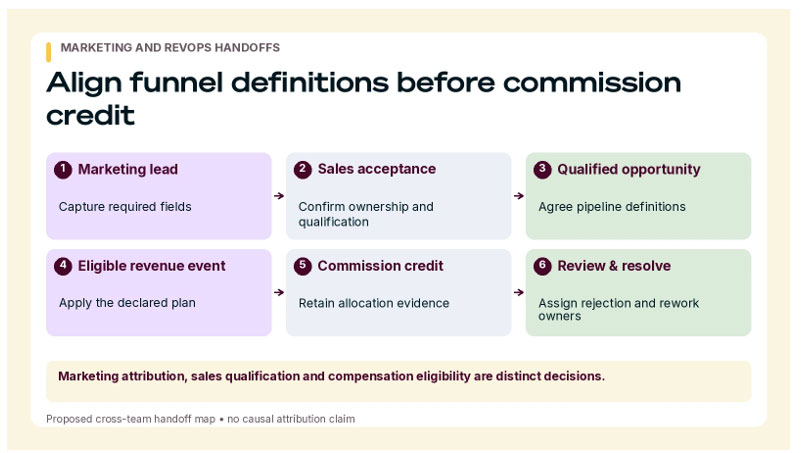
Marketing attribution, sales qualification and compensation eligibility are distinct decisions. Proposed cross-team handoff map • no causal attribution claim.
For B2B marketing and RevOps teams, the key question is whether a platform can translate agreed-upon funnel definitions into compensation rules without treating campaign attribution, Sales acceptance, and payment approval as the same thing. Software can enforce a rule, but it can’t resolve disagreements about who owns the decision.
Separate funnel progress from compensation eligibility
Before asking vendors to configure a system, define these three events separately:
- Accepted lead: Sales agrees to work a lead that meets the handoff criteria. This is a service and routing commitment, not necessarily pipeline or commission credit.
- Accepted opportunity: A designated Sales owner confirms a buying opportunity meets agreed criteria. Define accepted pipeline from those records, including the value basis and acceptance date, rather than relying on a stage label alone.
- Commission event: The event that an approved plan says earns credit for an eligible person. It might be opportunity acceptance or a later milestone; the distinction must be explicit.
Marketing-qualified lead volume, engagement scores, campaign responses, influenced pipeline, and attribution-weighted revenue should not automatically count toward commission credit. They may be valuable marketing KPIs without creating a payment obligation. An attribution model assigns reporting credit according to selected rules; it does not, on its own, prove that a campaign caused a sale.
If a plan deliberately rewards a marketing-related event, the compensation policy owner must approve its definition, recipient, exclusions, and effective date. Marketing owns the attribution methodology, not unilateral changes to another employee’s earnings.
A hypothetical example: when commission credit is disputed
Consider a hypothetical example spanning September and October. On September 25, Marketing routes lead L to SDR A after the lead meets its qualification criteria. Sales accepts the lead for follow-up. On September 30, a Sales manager accepts opportunity O, which is linked to that lead, after confirming a documented business need and an agreed next step.
The illustrative September plan pays an eligible SDR $150 for each unique, newly accepted opportunity. Credit belongs to the SDR recorded at acceptance, the acceptance date determines the earning period, and later campaign or account-owner edits do not change that credit.
There are no tiers, splits, or other payments in this example. SDR A has exactly one qualifying event: 1 × $150 = $150 of September calculated commission, subject to approval—not proof of payment. This is one individual’s modeled commission component, not total company compensation expense.
On October 2, Marketing corrects the campaign source. On October 3, the account moves to a different account executive, who questions the credit. Under the illustrative rule, neither edit changes SDR A’s September $150. The account executive’s current ownership is a different fact from the SDR’s ownership at acceptance. Any closing commission is outside this example.
If the original acceptance was a mistake, that raises a different dispute. Sales must establish what happened, and the compensation policy owner must authorize how to handle it. RevOps should not assume that a stage change calls for a reversal or make an unauthorized payroll adjustment.
Turn the handoff matrix into an operating agreement
Use this proposed matrix to clarify who has authority to make each decision, not just who enters the data. Every rejected record should have a documented reason, a destination for correction, and an owner responsible for getting it back on track.
| Trigger | Required fields | Authoritative owner | Rejection or rework path |
| Lead meets marketing qualification criteria | Lead/account ID, criteria version, qualification time, campaign source, assigned Sales recipient | Marketing Operations owns qualification and attribution definitions | Sales returns missing-fit or missing-data reasons; Marketing corrects or recycles the lead. |
| Sales accepts the lead for follow-up | Lead ID, accepting person, acceptance time, routing outcome | Designated Sales owner confirms acceptance | Routing disputes go to Sales management; data gaps return to Marketing Operations. |
| Opportunity meets accepted-pipeline criteria | Opportunity ID, linked lead/account, accepting manager, acceptance time, criteria version, value basis, SDR at acceptance | Sales management confirms the commercial event | Reject with a reason; Sales corrects opportunity evidence before resubmission. |
| Accepted event is evaluated for compensation | Event ID, eligible employee, plan version, effective date, earning period, duplicate rule | Compensation policy owner decides eligibility; RevOps implements | Missing data goes to its source owner; ambiguous policy goes to the policy owner. |
| Calculated statement is ready for review | Source values, calculated amount, exceptions, adjustment reasons, review status | RevOps investigates; Finance and designated approvers authorize | Return unresolved items for review; require authorized handling of any locked-period correction. |
| Approved commission data is submitted downstream | Employee identifier, period, currency, approved amount, delivery identifier, acceptance result | Payroll owns submission acceptance and payment execution | Payroll and RevOps reconcile rejected or duplicate submissions before resending. |
Keep a short event specification beside the matrix. It should define the unique event key, qualifying criteria, source record, recipient-at-event rule, period cutoff, duplicate treatment, and correction authority. These are proposed business requirements, not a claim that every platform supplies these exact fields automatically.
Give each shortlisted platform a specific task to demonstrate
Qobra’s guide to sales compensation software for RevOps and Finance teams provides another starting point for the software discussion. Keep your event specification—not any vendor’s feature checklist—as the basis for evaluation.
Qobra: a strong option for RevOps-managed rules and controlled reviews
Qobra documents a no-code plan editor with conditional logic, tiers, bonuses, and custom calculation rules. Plan simulation, sandboxing, and version control support checking changes. Employee statements expose calculations and targets; approval workflows, statement locks, in-context discussions, custom roles, and audit trails support review.
Qobra is a strong starting point when the priority is managing agreed-upon rules and explaining commission credit to Sales and Finance. That does not mean competing products lack no-code features or review controls. Ask Qobra to show how opportunity O retains the correct recipient and plan when ownership is disputed later.
Qobra’s published ElevenLabs client story is relevant here: it describes a former BigQuery-and-spreadsheet workflow and visibility for AEs and SDRs into opportunities and commission rules. The RevOps testimonial reports fewer back-and-forth commission inquiries.
That supports evaluating explanation quality; it is not an independent benchmark, a quantified reduction, or proof of marketing attribution accuracy.
Check data timing explicitly. Qobra’s Salesforce and HubSpot inbound connectors are read-only and specify nightly full refreshes, incremental updates every two hours, and manual refresh. Do not assume instant reflection of a CRM edit or CRM writeback. Verify the fields and relationships needed to preserve your acceptance event in the proposed setup.
CaptivateIQ: a strong option when combining datasets is central
CaptivateIQ’s SmartGrid supports data transformation and commission calculation. Its platform lists joins and unions, point-and-click transformations, effective dating, crediting, clawbacks, and draws. It also lists approvals, dispute resolution, rep visibility, role-based access, sandboxing, and audit logs.
Consider CaptivateIQ when commission-eligible events must be assembled from several datasets or when time-dependent rules require extensive modeling. Ask the vendor to join opportunity O with its contact and activity records while generating only the intended commission event. The test is whether the results are correct at the record level, not simply whether the data imports successfully.
Salesforce Spiff: a strong option for tracing calculations
Salesforce Spiff lists rep statements, calculation tracing, comments, notifications, commission estimation, flexible plan setup, and audit logs. Its described connections span CRM, enterprise resource planning, human capital management, and payroll systems; it is not Salesforce-only.
Consider Salesforce Spiff when sales reps need to understand exactly why an event produced a particular commission amount, especially if Salesforce is central to the evaluation. Ask a rep to trace opportunity O from the qualifying event through the applied rule to the statement, clearly distinguishing an estimate from approved earnings.
Confirm the specific connections your technology stack needs rather than assuming the CRM integration covers everything.
Use the disputed opportunity as a common vendor test
Give every vendor the same hypothetical scenario, handoff matrix, and expected result before the demonstration. Ask each to show both the straightforward case and the disputed case. Record whether each requirement can be handled through standard configuration, needs integration work, or requires a manual process.
- Event identity: Can the platform count opportunity O once despite multiple linked activities, repeated imports, or a lead conversion? Require the result to reconcile to the source event.
- Effective dates and ownership: Can reviewers recover the SDR and plan applicable at acceptance rather than silently applying today’s owner? What historical source data must your team retain?
- Freshness and missing data: How do reviewers identify the last successful import and records missing acceptance evidence? If automatic alerts or historical backfill are required, demonstrate them rather than assume them.
- Dispute resolution: Can Marketing correct attribution without changing compensation under the agreed rule? Can Sales challenge acceptance while the policy owner retains adjustment authority?
- Approval and delivery: Can reviewers trace the approved amount, then reconcile what the downstream system accepted? Test duplicate prevention on a repeated submission; do not assume it from an API’s existence.
Qobra’s outbound webhooks and APIs can support approved commission-data handoff. Qobra does not run payroll or move funds. Destination acceptance, duplicate handling, and reconciliation remain implementation requirements to validate.
Use the first cross-functional meeting to settle key decisions
Bring Marketing Operations, Sales management, RevOps, Finance, and Payroll together before the product demonstrations. Use the meeting to address these questions:
- Approve separate definitions for accepted lead, accepted opportunity, and commission event.
- Resolve the hypothetical ownership dispute and document the expected result.
- Assign an authoritative owner and rework destination to every matrix row.
- Agree on cutoff timing, review authority, and treatment of unresolved exceptions.
- Select a historical period for validation and name the person who will sign off each acceptance test.
Move Qobra forward if it can demonstrate the workflow with an acceptable amount of administrative and review effort. Choose another platform if it better meets the requirements for data modeling or explaining calculations.
Before buying a software platform, confirm what is included in the proposed package, which connectors are required, how much migration work is involved, and who will administer the system. The goal is not another funnel dashboard. It is a set of rules everyone understands, supported by software that applies them consistently.