Guest post by Sherjan Husainie.
Artificial intelligence (AI) is transforming industries by amplifying human expertise rather than replacing it. The most effective AI implementations don’t attempt to automate people out of the equation. Instead, they improve operational efficiency and reduce costs while preserving and often improving the quality of the work.
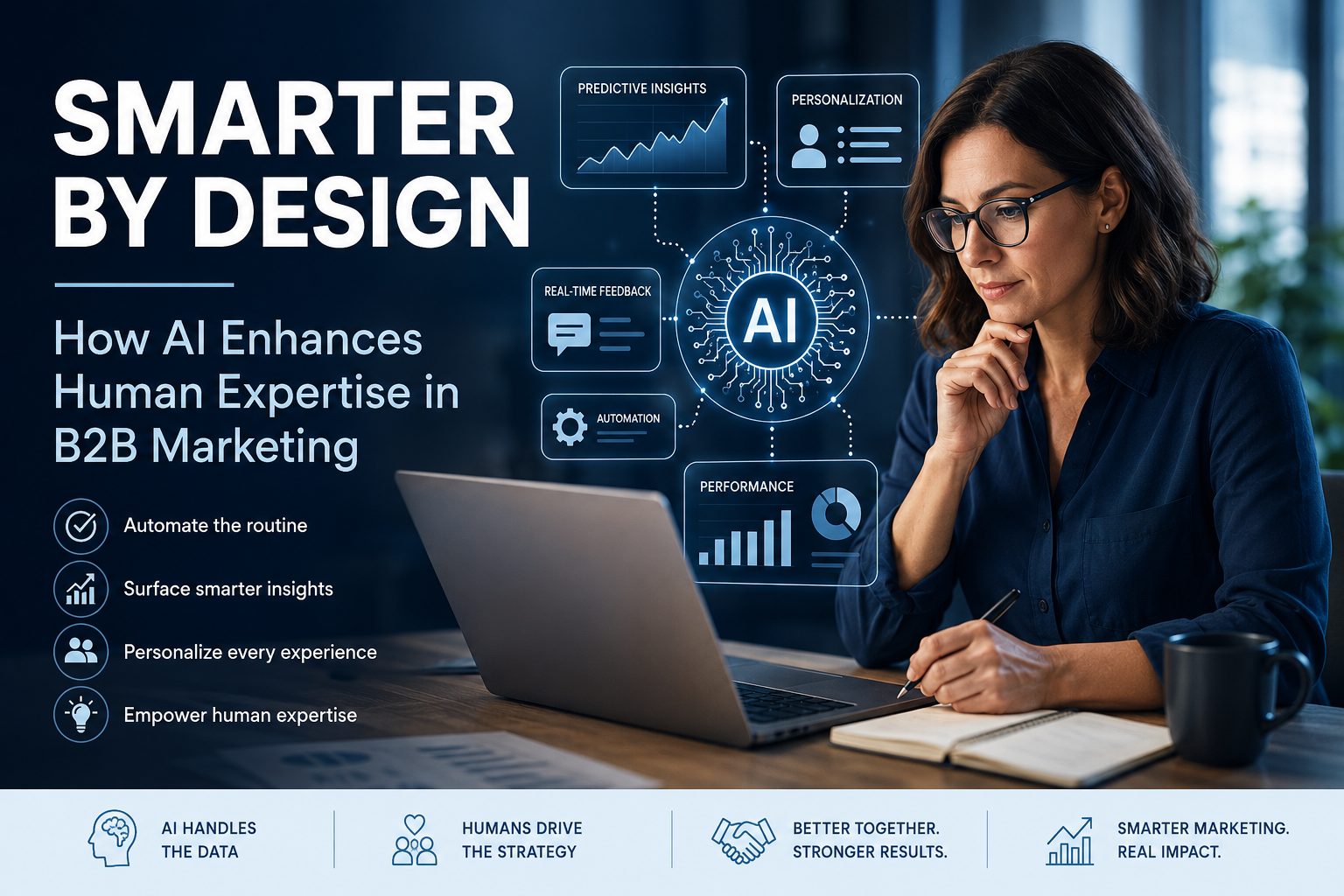 This shift is especially visible in fields where judgment, relationships, and creative strategy determine success. Rather than displacing the professionals who built that expertise, AI is increasingly deployed to extend that reach. AI tools can handle a volume of data and repetitive tasks that no team could reasonably process manually. This automation leaves strategic and relational decisions to the people best equipped to make them.
This article examines the rise of AI in human-centered industries and outlines six specific ways that AI enhances human expertise in B2B marketing.
The Rise of AI in Human-Centered Industries
Across sectors, organizations are adopting AI to strengthen the human expertise, judgment, and relationships that ultimately drive value. The pattern is consistent: AI absorbs administrative, analytical, and repetitive workloads so that skilled professionals can focus their attention on creative, complex, and relational work.
B2B exemplifies this shift. Leading firms use AI to automate repetitive tasks, process buyer intent signals, and generate real-time feedback. This frees human marketers to concentrate on deep industry expertise and authentic brand storytelling.
Six Ways to Use AI for B2B Marketing
- Low-value task automation
- Predictive decision support
- Real-time feedback
- Personalization at scale
- Cognitive load reduction
- Expertise gap closure
1. Low-Value Task Automation
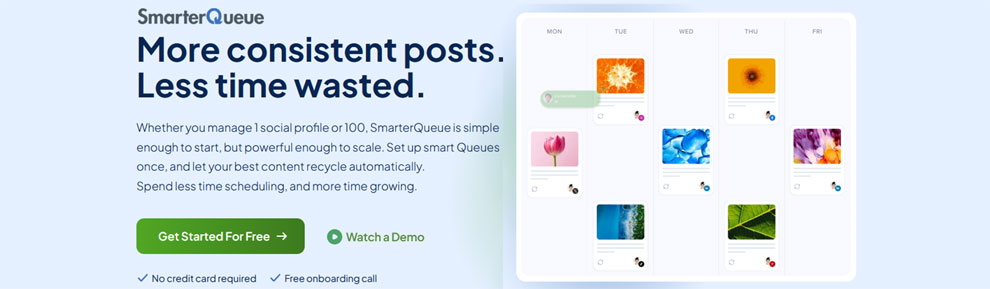
One of AI’s most immediate contributions to B2B marketing is eliminating time spent on low-value tasks. Pulling performance reports, scheduling social posts, tagging assets, and formatting data consume hours without generating much strategic value. AI tools can now handle this work, freeing human marketers for higher-value priorities.
Media monitoring illustrates this well. Rather than manually reviewing alerts and compiling coverage reports, marketers can use AI to synthesize coverage across sources, identify key themes, categorize sentiment, and produce summary reports in a fraction of the time.
AI can also support keyword research, A/B test analysis, drafting meta descriptions, and campaign performance reporting. Once relieved of these tasks, marketers can devote more attention to brand voice, building relationships, and creative strategy.
2. Predictive Decision Support
AI narrows the gap between raw data and quick, confident decision-making. Marketing teams today have access to vast volumes of audience data, and it is more than any individual could reasonably analyze by hand.
AI tools can identify patterns across large, complex datasets while surfacing the signals that require immediate attention. This allows senior marketers to identify which accounts in their database show buying intent before a purchase occurs.
By analyzing website behavior, content consumption, and third-party data, AI can flag which campaigns are most likely to generate pipeline. They can also surface emerging issues before they escalate into larger problems.
Instead of reviewing dashboards manually and hoping to catch meaningful trends, marketing leaders can rely on AI to point them toward the accounts and campaigns that matter most in a given week.
3. Real-Time Feedback
AI shortens the lag between insight and action. Waiting for quarterly reports to assess campaign performance is a luxury few B2B marketing teams can afford. That budget is often spent before ineffective approaches are identified and corrected.
B2B sales cycles are long and vulnerable to both messaging misalignment and targeting errors that can go unnoticed for weeks. Instead of surfacing these issues after the fact, AI tools surface audience engagement, conversion, and sentiment signals in real time. This gives teams the ability to course-correct in real time, before a flawed campaign consumes an entire quarter’s budget.
This shifts marketing leadership from a reactive role to a proactive one. Brand sentiment monitoring and share-of-voice tracking, among other real-time analytics, give leaders the visibility needed to make faster and more informed decisions. They also allow them to demonstrate that visibility to stakeholders who expect data-backed reasoning behind every single budget decision.
4. Personalization at Scale
AI has changed what is possible in B2B personalization. AI tools can analyze firmographic data, behavioral signals, content engagement patterns, CRM history, and third-party intent data simultaneously. This enables marketers to dynamically adjust messaging, content recommendations, and outreach timing.
This raises the ceiling on personalization without requiring proportional increases in headcount. A prospect who has primarily engaged with thought leadership content receives different follow-up content than one who has been focused on technical documentation.
AI can also support localization personalization (e.g., directing New York City area prospects to the nearest relevant shop locations in NoHo, Brooklyn, and Williamsburg).
Rather than building static segments and manually mapping content to them, marketers can design dynamic systems that respond to prospect behavior as it unfolds. This shifts their focus from execution to strategic judgment about which signals matter most and which experiences are worth building around them.
5. Cognitive Load Reduction
AI reduces the cognitive burden on senior marketers, allowing them to think more strategically. Traditionally, marketers juggled report review, pipeline metrics, and campaign troubleshooting simultaneously. This was often at the expense of deeper strategic work. AI now absorbs much of that mental load.
AI tools consolidate information, filter out noise, and surface the data points that matter most. The most advanced models can also often make comprehensive recommendations rather than static observations.
Freed from constant metric-tracking, marketers can apply sharper creative judgment and prioritize more effectively, spending their limited time on the decisions that actually move the business forward.
6. Expertise Gap Closure
AI also closes expertise gaps within marketing teams. Most teams have deep expertise only in certain areas and clear gaps in others. For example, a team may be strong in content strategy but be thin on technical SEO. AI functions as a shared knowledge layer that fills those gaps without requiring every team member to become an expert in every discipline.
Junior marketers can use AI tools for foundational frameworks and first drafts rather than relying heavily on senior staff for every question. Similarly, demand generation specialists without deep expertise can use AI to produce optimized copy that would otherwise require pulling in a specialist.
Senior marketers rarely have the bandwidth to apply expert judgment to every issue that arises across a growing roster of campaigns and clients. AI can handle much of the research, synthesis, and structural thinking that would otherwise fall to senior staff. Closing those expertise gaps both supports junior team members while freeing leadership to focus on the highest-priority decisions.
Key Takeaways
B2B marketing is one of many human-centered industries adopting AI to improve efficiency without expanding headcount. Firms are using AI to personalize at scale, deliver real-time feedback, and automate low-value tasks. They are also using it to support predictive decision-making, reduce cognitive load, and close expertise gaps across their teams.
The most successful marketing teams will not be the ones that adopt AI most aggressively, but those that use it deliberately to enhance human expertise rather than replace it. The result is a workforce that operates with sharper focus, greater speed, and significantly higher impact, and they do so without sacrificing the human judgment and creativity that no algorithm can fully replicate.
 Sherjan Husainie is the Founder of KIRO, the world’s most advanced chiropractic brand. He studied Aerospace Engineering at the University of Toronto and Financial Engineering at UCLA Anderson. Before founding KIRO, Sherjan worked at Google and was a Vice President in Investment Banking at Morgan Stanley. His mission is to make modern, accessible chiropractic care available to 100 million members globally.