Forbes recently reported on a less-than-one-year-old startup focused on “Generative Engine Optimization” (getting your brand or content to appear in AI searches) valued at over $100 million. Can any company that sells a tool which is basically a new twist on traditional SEO tech really be worth that much? Maybe. But there are reasons to be skeptical.
 To be clear, this is not a criticism specifically of Profound, which recently raised $20 million from Kleiner Perkins. The kind of people who can raise and invest sums like that typically do their homework pretty thoroughly. And the founders are clearly pretty smart as well—smart enough to raise Rand Fishkin-level funding.
But there are four big reasons to be skeptical of any magical new tool for generative engine optimization (GEO):
1) Artificial intelligence (AI) platforms and their underlying large language models (LLMs) are constantly evolving. Even if there were “one weird trick” for appearing in AI searches today, it may not work tomorrow.
2) Asking the same question in just a slightly different way can produce wildly different results. Christopher Penn does a great job of illustrating this in his recent piece, Setting the Record Straight on AI Optimization. It’s a long and somewhat technical read (and note that he also uses the term “snake oil”) but worth your time if you really want to dig into GEO.
3) Every AI platform works a bit differently. The differences between results on Gemini vs. ChatGPT vs. Perplexity are typically much greater than the differences between results for the same search term on Google, Bing, and Yahoo!.
4) To the large extent that GEO is an extension of SEO, the major SEO tool vendors—Semrush, Ahrefs, Serpstat, SE Ranking—either have or are working on AI search optimization features within their suites.
The Forbes article also makes points which are just plain wrong. It quotes a cybersecurity executive saying, “The industry is really turned on its head because traditional ways of eventually (sic) SEO just don’t work anymore.” Nonsense.
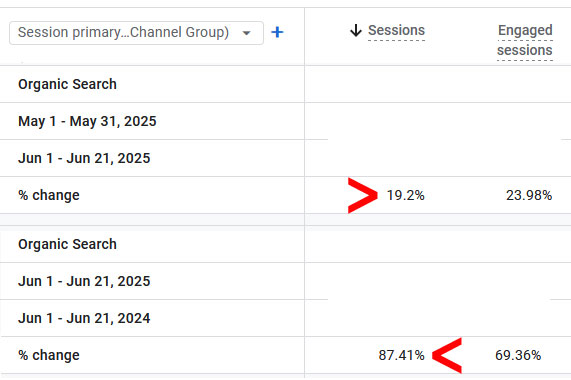 First, solid SEO still works. Not every site is losing search traffic to AI searches. Here’s one client example at right.
Second, even if more search queries are answered by AI rather than clicks, traditional SEO is still required as the basis for AI search optimization. It’s not sufficient, but it is essential.
Optimizing for AI searches isn’t easy but it isn’t mysterious either. I’ve published several posts here recently on the topic of AI search optimization or GEO, including How Will AI Search Impact SEO? Chris Penn Provides the Best Answers Yet from last spring, and most importantly Optimizing for AI Overviews and AI Searches Make WPO Matter More Than Ever.
That post notes how the web presence optimization (WPO) model, originally developed more than a decade ago and refined several times since, lays out the basis for a GEO strategy. For now at least, you can also view an interactive version of the WPO model on the B2B marketing technology site (it’s up for sale).
And as noted above, Christopher Penn has written a detailed article on optimizing for AI search. If you don’t have time to read his entire 4,300+ word article, in a nut shell the key components of AI optimization are:
- Traditional SEO;
- Branding;
- Content creation, distribution, and amplification (i.e., content marketing); and
- PR.
Oh, and in case you’re curious, here is ChatGPT’s answer to my query at the top of this post:
1. Create Expert-Level, Factual, and Well-Structured Content
AI tools favor content that’s clear, trustworthy, and answer-worthy.
Best Practices:
-
Use clear headings, short paragraphs, and structured formats (FAQs, bullet points, how-to lists).
-
Incorporate E-E-A-T principles: demonstrate Experience, Expertise, Authoritativeness, and Trustworthiness.
-
Add dates, sources, and author bios (with credentials) to build credibility.
-
Include definitions, examples, and summaries AI models can quote easily.
2. Target AI-Focused Keywords and Natural Queries
LLMs are trained on natural language—so write for how people talk, not just what they type into Google.
Tactics:
-
Use long-tail, conversational keywords (e.g., “What is the best CRM for freelancers in 2025?”).
-
Incorporate questions and answers in your content (AI pulls from these for summaries).
-
Use tools like AlsoAsked, Answer the Public, or ChatGPT itself to find query-based phrasing.
3. Get Cited or Mentioned on High-Authority Sites
AI search tools often reference or summarize trusted domains or sources mentioned widely online.
Strategy:
-
Pursue backlinks from high-authority websites, especially .gov, .edu, news, or respected industry sites.
-
Get featured in expert roundups, directories, and press mentions.
-
Use platforms like HARO, Featured.com, or SourceBottle to be quoted.
4. Implement Structured Data and Semantic Markup
Structured data helps AI “understand” your site better.
Use:
-
Schema.org markup for articles, FAQs, products, reviews, and how-to guides.
-
Open Graph and Twitter Card tags for clean previews across platforms.
-
Breadcrumb schema to show content hierarchy.
5. Publish High-Quality, Evergreen Content Consistently
AI tools often pull from recent, informative, and well-maintained pages.
Tips:
-
Keep URLs and pages updated (even if just the publish date and intro).
-
Regularly refresh top-performing content with current data or stats.
-
Create timeless “explainer” pages that build trust and authority over time.
6. Be Discoverable by AI Crawlers and Integrators
Some AI tools scrape or cite sites directly, while others pull from sources like Bing, Reddit, or Wikipedia.
Actions:
-
Make sure your content is crawlable (no robots.txt blocks on important pages).
-
Get listed on knowledge platforms: Wikipedia, Crunchbase, GitHub, LinkedIn, etc.
-
Optimize your site’s performance and mobile-friendliness, as many AI search tools check page experience.
7. Be Citable: Give AI a Reason to Reference You
Make your content so reliable, unique, and quotable that AI tools can’t ignore it.
Examples:
-
Publish original research, stats, or case studies.
-
Offer definitive how-to guides or glossaries on niche topics.
-
Use canonical phrasing that makes it easy to lift into summaries (e.g., “In digital marketing, a funnel is…”).
Bonus: Monitor AI Mentions and Performance
-
Use tools like Perplexity.ai, ChatGPT browsing, or Bing Copilot to check if/when your content appears.
-
Set up brand alerts (via Google Alerts or Brand24) to track citations in AI responses or on Q&A platforms.
Hi Tom, “Even if there were “one weird trick” for appearing in AI searches today, it may not work tomorrow.” is just like it was with SEO.
It’s all ever changing and what works on day may not work another.
Stick to the basics like you explained with E-E-A-T and be sure your brand name gets mentioned and used more to gain that brand visibility today.
Thanks for sharing about this new “snake oil” on the rise Tom!
You are so right Lisa, thanks. Be helpful, expert, and visible. There’s a little more to the details, but at a high level, a focus on “being the best answer” will serve brands well wherever their prospects are searching.