What truly drives trust in B2B marketing: brand awareness, product innovation, or peer validation? How do customer endorsements and category relevance stack up against price competitiveness and feature differentiation? And where in the funnel does trust create the greatest competitive advantage?
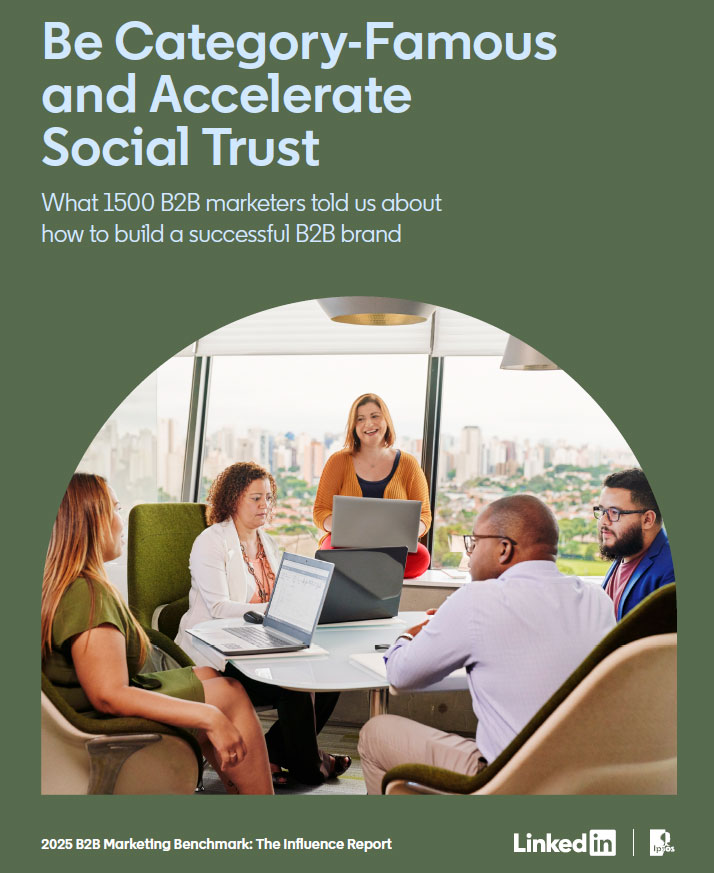 Find the answers to those questions and more in the Be Category-Famous and Accelerate Social Trust report from LinkedIn.
For senior B2B marketers and marketing decision-makers, this report makes a clear and compelling case: trust is not a soft metric or a branding afterthought. It is the strategic foundation of sustainable growth, and it is built less through broad fame and more through category-specific validation, peer credibility, and social proof across the funnel.
Here are eight specific findings from the LinkedIn report’s authors, Mimi Turner and Jann Schwarz.
1. Trust Is the Most Important Factor in B2B Brand Success
When asked directly whether building trust is the most important factor for achieving success as a B2B brand, 93.7% of marketers agreed or strongly agreed (page 6). Only 1% disagreed outright. That level of consensus is rare in marketing research. It signals that trust is no longer viewed as a halo effect or secondary outcome; it is seen as the core strategic lever behind influence, growth, and competitive advantage.
The implication is clear: if trust is foundational, then the tactics used to build it must be treated as primary investments, not optional branding task items.
2. Customer and Peer Recommendations Outweigh Price and Features
In a progressive rating exercise (page 8), marketers consistently ranked customer recommendations and peer endorsements as more influential than price competitiveness, advanced features, or being a household name. In fact, customer recommendations were 1.25x more influential than price competitiveness, and peer recommendations were 1.27x more important than being a household name.
This challenges a common internal narrative. Many organizations still default to feature launches, pricing strategies, and innovation messaging as primary growth drivers. The data suggests marketers themselves believe relational proof matters more.
3. When Forced to Rank, Proof Beats Popularity
When marketers were required to strictly rank factors influencing trust (page 9), the findings sharpened. Being recommended by customers was ranked first by 35.8% of marketers, and peer recommendations by 15.9%. Combined, those signals of category relevance far outweighed fame or price competitiveness.

Image credit: LinkedIn
Notably, “category famous” scored just 10.1% when ranked explicitly. Yet marketers implicitly chose category relevance through their prioritization of peer and customer validation. This gap between what marketers say explicitly and what they prioritize implicitly is one of the more interesting tensions in the report.
It suggests an opportunity: reframing “category fame” not as vanity awareness, but as earned relevance within a specific buying ecosystem.
4. Recognition Is More Defensible Than Price
In forced-choice comparisons (page 11), marketers overwhelmingly favored brand recognition over cost leadership. 80.7% selected “a brand that is widely recognized across the industry” over “the most cost-effective brand.”
The report notes that brand reputation was seen as more than four times as defensible as price competitiveness. This is a critical insight for B2B firms tempted to compete on margin-eroding discount strategies. Recognition, especially within the category, creates insulation against commoditization.
From now until March 31, 2026, enter code VEEDSPRING20 to get 20% off your first year on the Pro plan! (new customer / annual plans only)
5. Peer Credibility Beats High Awareness
When asked to choose between high brand awareness and peer recommendation (page 11), 62.3% of marketers chose peer credibility. In other words, general fame is less powerful than endorsement from respected insiders.
This reinforces the report’s core thesis: trust is socially constructed. It spreads through validation networks, not just impressions and reach. For B2B marketers, this elevates advocacy programs, community building, and co-marketing with customers from tactical add-ons to strategic imperatives.
6. Endorsements Outperform Innovation Alone
In another forced-choice comparison (page 11), 68.7% of marketers preferred a brand with strong customer endorsements over one known for cutting-edge innovation but lacking proof.
This doesn’t mean innovation is unimportant, of course. But innovation without validation is flimsy. In high-stakes B2B buying environments, especially with large buying groups and risk-averse stakeholders, emotional safety and demonstrable results outweigh theoretical superiority.
7. Trust Requires Visibility and Social Proof
The report also examines barriers to building trust (page 14). Interestingly, there is no single dominant obstacle. Instead, several related factors cluster together: lack of product differentiation (30%), lack of awareness (28%), insufficient case studies or proof (27%), and absence of customer advocacy (24%).
The takeaway is striking. Marketers believe that invisibility and lack of endorsement are liabilities. Trust cannot exist “in secret.” Without category awareness and visible validation, even strong offerings struggle to build confidence.
This finding adds nuance to the awareness-versus-trust debate. Awareness alone is insufficient, but the absence of awareness undermines trust.
8. Trust Is a Full-Funnel Activity
One of the report’s strongest sections examines how trust manifests across the funnel (page 16).
At the top of the funnel, being known as a trusted and reliable brand within the category was more than twice as important as being a household name. Being known and trusted was 1.25x more important than being memorable or recognized as innovative.
In the middle of the funnel, third-party validation dominates. Being named the top solution by analysts received the largest share (37.9%), and video testimonials were 20% more effective than written versions. Expert and customer endorsements significantly outperformed company-produced content.
At the bottom of the funnel, the most surprising insight emerges. While functional levers like free trials and personalized solutions matter, what marketers most want is a more intelligent lead-scoring system. They prefer better qualification over higher volume. In fact, marketers believe a smarter scoring system that surfaces higher-value leads would close more deals, even if overall lead counts decline.
This finding shifts the focus from “more leads” to “better signals.” Trust at BOFU is not just relational, it’s operational.
Light Critical Analysis: What’s Missing?
The report makes a persuasive, data-backed case for prioritizing social validation and category fame. However, two questions remain.
First, while marketers overwhelmingly prioritize trust, the study is based on self-reported perceptions. What marketers believe drives growth may not always align perfectly with what financial performance data would show. It would be valuable to see trust metrics correlated directly with revenue or pipeline performance.
Second, the report champions peer and customer endorsements, but it does not deeply explore how organizations can systematically scale advocacy. Advocacy is easier to endorse conceptually than to operationalize at scale. More practical frameworks for turning customers into active advocates would strengthen the prescriptive power of the findings.
That said, the directional clarity of the research is hard to ignore.
Final Thoughts on Category Fame and Social Trust
For senior B2B marketers, the message is both validating and challenging. Validating because it confirms what many intuitively know: trust is the foundation of sustainable brand success. Challenging because it demands a shift away from feature-first messaging, price competition, and broad awareness toward a disciplined strategy of category relevance, social proof, and intelligent lead qualification.
In the Be Category-Famous and Accelerate Social Trust report, LinkedIn’s head and senior director of marketplace innovation, Mimi Turner and Jann Schwarz, argue that B2B growth comes not from being famous everywhere but from being trusted where it matters most. For organizations willing to treat advocacy, validation, and smarter signals as strategic assets, the report provides a compelling roadmap for earning that trust across the funnel.
ChatGPT assisted with research for this post.