Guest post by Peter Johnson.
A CEO walks a trade show floor, stops at a competitor’s booth for eleven seconds, and forms an opinion that no amount of digital reputation management will undo before the next quarter’s renewal conversation. That’s not a hypothetical.
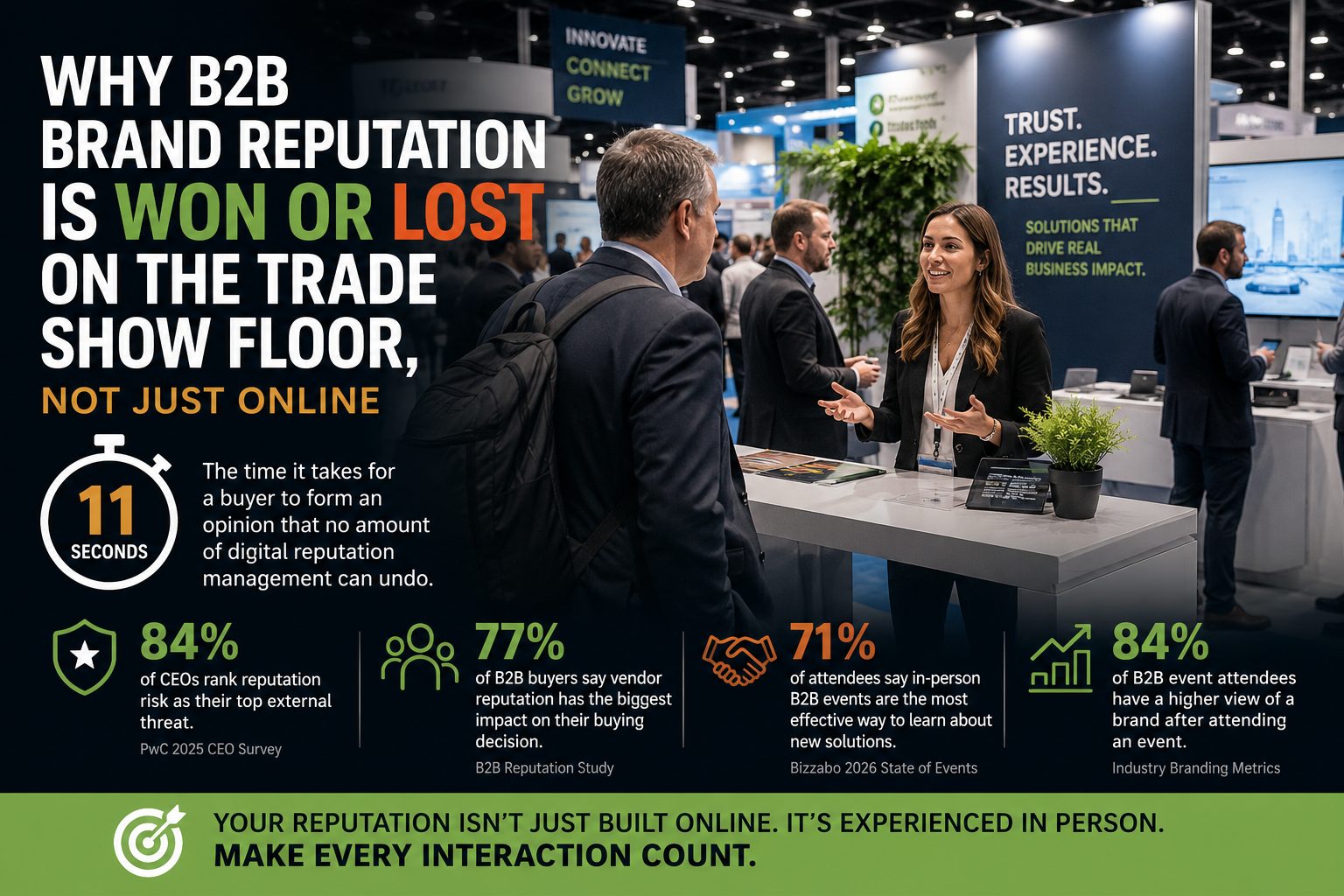 It’s roughly how fast in-person judgment forms, and it’s happening constantly at exactly the events where B2B companies have spent the least strategic effort protecting their reputation.
Reputation management has become an executive-level concern. According to PwC’s 2025 CEO Survey, 84% of global CEOs now rank reputation risk as their top external threat, ahead of both cyber and regulatory risk. Nearly all of the resulting investment, however, flows into digital monitoring: review response protocols, social listening tools, AI search visibility.
Comparatively little strategic attention is paid to the physical, face-to-face side of B2B reputation—the trade show floor, the executive briefing center, the sponsored conference booth, even if this carries outsized weight in how buyers actually judge a vendor.
That disparity deserves significantly more examination than it’s getting now.
Reputation Is Built on Direct Evidence, Not Just Digital Signals
B2B buyers place a lot of weight on vendor reputation before making any purchase decision. B2B reputation studies’ data shows that 77% of B2B buyers think that vendor reputation has the biggest impact on their buying choice, and 45% of firms claim that they have lost major agreements or relationships because of unfavorable perception.
Most reputation strategy does this via digital channels: review sites, search exposure, and consistent messaging across owned media.
A trade show booth, an executive briefing center, or a sponsored conference presence is a different kind of reputation signal entirely. It is direct, unfiltered evidence, gathered by a buyer through their own senses rather than mediated through a review site or a curated LinkedIn feed.
LinkedIn’s 2025 B2B Marketing Benchmark, conducted with Ipsos across 1,500 senior B2B marketers, found that 94% agree trust is the key factor in B2B success, and 42% of senior marketers now rank increasing brand awareness and reputation among decision-makers as their top business priority for the year. Very little of that research, however, extends the same rigor to physical brand presence that it applies to digital reputation management.
The Data on In-Person Impact Is Stronger Than Most Reputation Strategies Account For
Event-specific research reinforces how much weight in-person experience carries. Bizzabo’s 2026 State of Events Benchmark Report found that 78% of event organizers consider in-person conferences, summits, and conventions their organization’s most impactful marketing channel, and 71% of attendees believe in-person B2B conferences offer the most effective way to learn about new products or services, ahead of digital channels evaluated in the same research.
The reputational effect of a strong event presence is also measurable after the fact. Industry branding metrics show that 84% of attendees at B2B marketing events had a higher view of a brand after attending an event, a lift that most digital-only reputation campaigns would take far more consistent work to achieve.
That is to say, one properly executed physical presence can influence brand impression more efficiently than months of incremental digital reputation work, yet it rarely gets the funding or planned focus commensurate with that impact.
Where Physical Presence Quietly Undermines Reputation Instead of Building It
The inverse is equally true, and less frequently discussed. A generic, poorly staffed, or visibly under-invested booth does not read as a neutral non-event to a buyer walking the floor. It reads as evidence. Buying committees are doing more and more homework before they even talk to a vendor. And having a physical presence that doesn’t match a company’s digital positioning – a slick website and a forgettable booth, for example – introduces exactly the sort of inconsistency that reputation research always identifies as damaging.
According to buyers, consumers lose trust when they see contradictory information across touchpoints, and a difference in digital and physical brand presentation is a type of that inconsistency, just experienced in person, not online.
That is increasingly, not less, important as AI-driven search and summarization starts to influence early-stage vendor perception. AI tools are increasingly being used by executives to research potential vendors before they even speak to a salesperson, and the physical impression made at a conference or trade show often becomes the anecdote, case study or word-of-mouth referral that ends up in exactly the kind of earned-media content those artificial intelligence systems are pulling from.
A forgettable physical presence does not simply fail to help, it robs a possible source of the reliable, human-sourced information that reputation strategy increasingly rely on.
Treating Physical Presence as a Reputation Channel, Not Just an Event Line Item
This data leads to some practical shifts.
Reputation and events teams rarely coordinate closely, despite influencing the same buyer perception from different angles. Physical presence planning, including the work of booking meetings before the show even starts, deserves the same reputation-conscious scrutiny as post-event follow-up, rather than being treated purely as an events or logistics function.
Post-event reputation measurement should be as rigorous as digital sentiment tracking. Structured post-event surveys can measure changes in attendee perception, whether a booth or briefing center left visitors with a more or less favorable view of the brand. But this data is rarely linked back to broader reputation metrics the way review sentiment or search visibility already is.
Consistency between digital and physical brand presentation deserves explicit review before a major event, not an assumption that existing brand guidelines will translate automatically. A brand that has invested heavily in transparency and credibility online undermines that investment if its physical presence at a flagship event fails to reflect the same standard.
Conclusion
Reputation management has matured considerably as a digital discipline over the past several years, extending into AI search visibility, review response protocols, and executive social presence. The physical dimension of that same reputation, formed in person, at scale, in front of exactly the buyers a company most needs to influence, has not kept pace.
Here’s the uncomfortable part: every dollar spent perfecting a digital reputation strategy can be undone by eleven unmanaged seconds at a booth nobody thought to brief properly. The data above makes the case plainly. In-person experience moves buyer perception faster and more durably than almost any digital channel measured.
Organizations that recognize this next will not be the ones with the biggest events budget. They’ll be the ones who finally started treating the show floor as what it actually is: a reputation channel, not a logistics line item.
Peter Johnson is a Digital Marketing Executive at Exhibit Elevate, a global exhibition stand design and build company operating across Dubai, the UK, Germany, Poland, and the US. He writes about the intersection of B2B event strategy, brand reputation, and physical brand experience.